
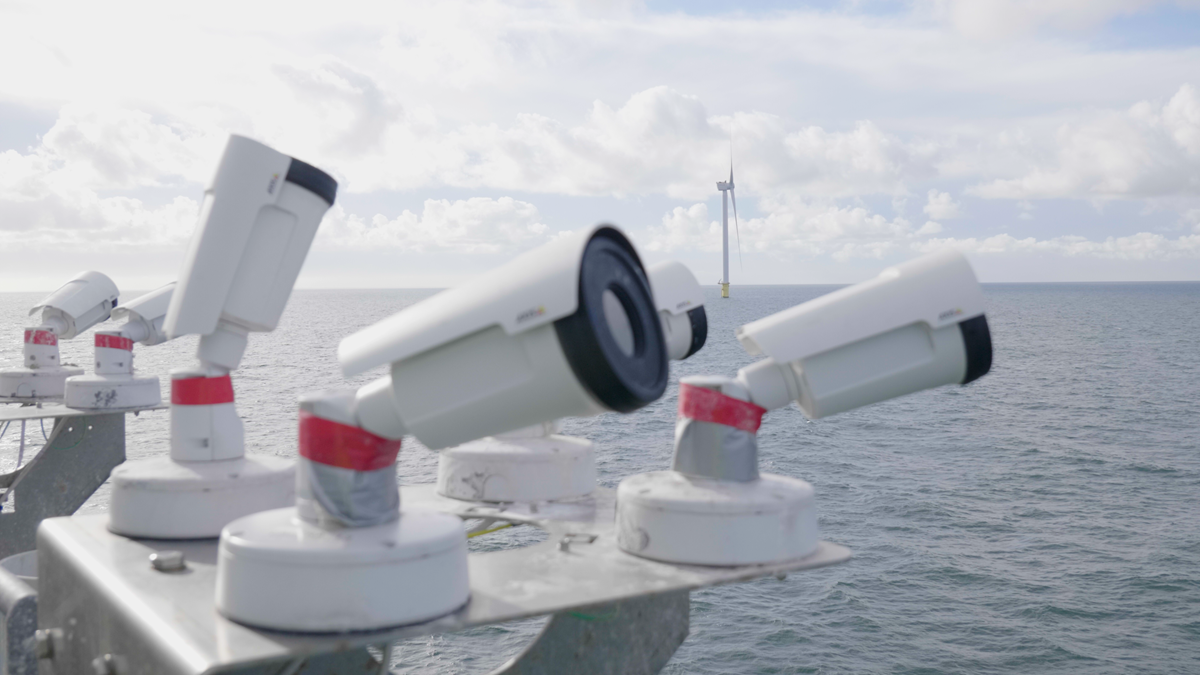
A year-long trial using thermal cameras and artificial intelligence (AI) at the Hollandse Kust Zuid offshore wind farm in the Dutch North Sea has generated new field data on bird activity and potential collisions with wind turbines.
The technology was able to detect bird movements around a turbine both day and night and identify potential collision events under offshore conditions, according to the researchers.
The trial involved 16 thermal cameras supplied by Wildlife Imaging Systems (WIS), installed on a single turbine. The cameras continuously monitored the area around the turbine in all directions.
Combining thermal imaging with AI enabled the system to detect birds and bats after dark, including during periods of fog and rain.
Wageningen University & Research (WUR) analysed the data collected during the trial to assess the system’s performance. The findings provide insight into the potential of the technology, as well as areas where further development is needed.
First field data on collision risk
Monitoring continued for almost a year and covered two migration seasons. During this period, the system recorded 22 potential bird collisions.
Two incidents were confirmed as collisions, while a third was classified as a collision with a high degree of probability.
The results add to existing knowledge of collision risk at offshore wind farms. Unlike onshore sites, where carcass searches can be used to monitor turbine-related bird mortality, birds killed at sea generally cannot be recovered.
According to Vattenfall, co-owner of the wind farm, together with BASF and Allianz, this has meant that previous estimates of offshore collision rates have largely relied on theoretical models.
The monitoring system was able to detect small migratory birds during nocturnal migration, as well as bats in darkness and larger bird species during daylight hours.
WUR said the technology could provide a way of studying collisions more directly and linking individual events to local environmental conditions.
Further research planned
The research will continue with monitoring at different locations and under a wider range of environmental conditions. Further development of the monitoring technology is also planned.
The aim is to improve understanding of the conditions under which bird collisions occur at offshore wind turbines. Such data could help inform the development of targeted mitigation measures for offshore wind farms.
Source and image credit: Vattenfall.