
Direct answer
A solar EPC company manages the complete delivery of a solar power plant: engineering the system, procuring specified equipment, constructing and connecting the plant, testing it and handing it over for operation. For commercial and industrial projects, a capable EPC partner also coordinates structural and electrical studies, statutory approvals, safety, monitoring, documentation and post-installation support.
A solar project for a factory, warehouse, hospital, school, office or retail facility is not simply a panel installation. It is an energy infrastructure project that must connect engineering, procurement, construction, approvals, safety, commissioning and long-term performance. The right solar EPC company brings those responsibilities under one accountable contract and designs the plant around the facility’s load, roof or land, operating schedule and financial goals.
India had 168.04 GW of installed solar capacity as of 31 August 2026, including 32.59 GW of grid-connected rooftop solar, according to the Ministry of New and Renewable Energy. MNRE physical progress data shows how quickly the market is scaling, but a growing market also makes provider selection more important: project owners need to compare engineering quality and lifecycle accountability, not only the lowest price per kWp.
Quick takeaways
- A true turnkey EPC scope covers design, procurement, construction, grid connection, commissioning and handover, with responsibility defined in one contract.
- The best system size is based on interval consumption, sanctioned load, usable site area, daytime demand, export rules and business objectives, not on monthly bill value alone.
- Compare proposals using the same equipment specifications, generation assumptions, exclusions, warranties, performance commitments and O&M scope.
- Commercial and industrial projects should not assume residential rooftop subsidies apply; incentives, tax treatment and metering rules must be checked for the consumer category and state.
- Lowest upfront price is not automatically the lowest lifecycle cost. Design losses, component substitutions, downtime and weak service can erode expected savings.
- A bankable decision requires a technical feasibility report, itemised commercial offer, clear contract, approval responsibility matrix and measurable handover criteria.
What is a solar EPC company?
EPC stands for Engineering, Procurement and Construction. In solar, the EPC contractor converts a business requirement and a site into a commissioned power plant. The EPC company may also provide operations and maintenance (O&M), monitoring and performance support, but those services should be stated separately in the contract rather than assumed.
| EPC stage | What it should include | Decision that matters |
| Engineering | Load analysis, site survey, shadow study, structural and electrical design, energy-yield model, single-line diagram and approval plan | Is the plant designed for the facility and its operating pattern? |
| Procurement | Modules, inverters, mounting structure, cables, protection equipment, monitoring system and balance-of-system items | Are makes, models, standards, warranties and substitution rules fixed? |
| Construction | Civil and structural work, mounting, cabling, earthing, protection, quality checks and site safety | Can work be completed safely with minimal disruption to operations? |
| Commissioning and handover | Testing, grid synchronisation, meter/approval coordination, baseline performance checks, as-built drawings and training | What evidence proves the plant is complete and performing as contracted? |
Solar EPC company, installer and developer: what is the difference?
An installer may focus mainly on physical installation. An EPC contractor owns the integrated design-to-commissioning scope. A solar developer may arrange land, finance, permits and power sale under an OPEX, RESCO or power purchase agreement (PPA) model. Some companies perform more than one role, so buyers should identify the legal entity responsible for design, construction, warranties, plant performance and long-term service.
Why businesses choose turnkey solar EPC
- Single-point accountability reduces coordination gaps between designers, suppliers, installers and approval consultants.
- Site-specific engineering helps match generation to daytime consumption and reduces avoidable export or curtailment.
- Controlled procurement makes equipment quality, compatibility, warranties and delivery schedules easier to manage.
- Structured construction planning can protect business continuity, roof integrity and worker safety.
- Documented testing and monitoring provide an operating baseline for identifying underperformance.
- A complete commercial model helps management evaluate cash flow, payback, risks and long-term energy cost.
End-to-end Solar EPC Services

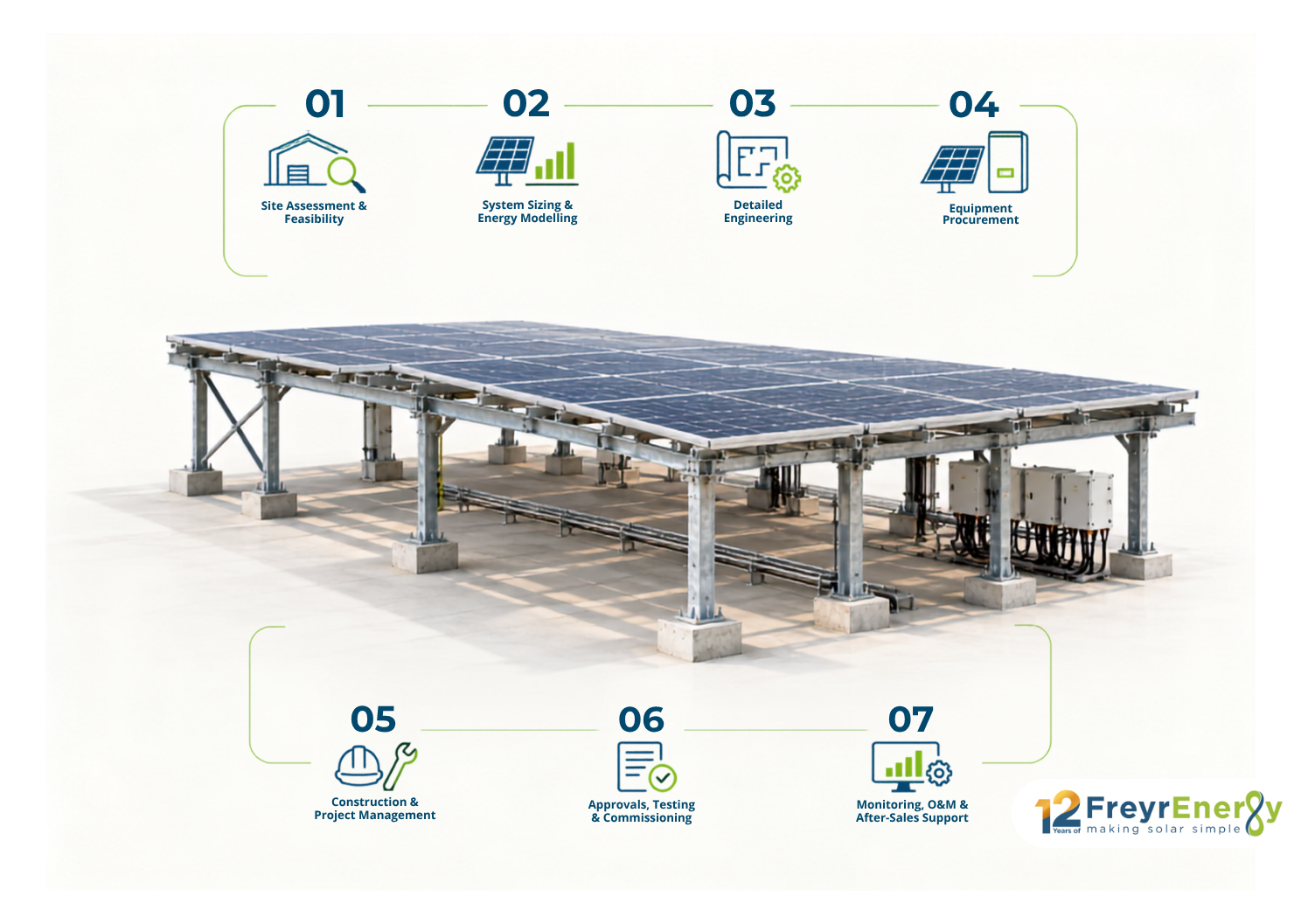
The scope below is the practical baseline for a commercial or industrial project. Exact responsibilities should be converted into a written responsibility matrix before contract signing.
1. Site assessment and feasibility
The EPC team should review electricity bills and interval data, sanctioned load, contract demand, transformer capacity, operating hours, roof drawings, structural condition, shading, access, fire pathways, drainage, water availability and any future expansion. For ground-mounted plants, the study also covers land, geotechnical conditions, access roads, flooding risk and evacuation route.
2. System sizing and energy modelling
A useful proposal shows how system capacity was derived, expected monthly generation, self-consumption, exports, losses, degradation assumptions and scenarios for load growth. The generation estimate should state its weather dataset, modelling method and uncertainty; a single annual number without assumptions is difficult to audit.
3. Detailed engineering
Detailed engineering typically includes module layout, inverter configuration, DC/AC ratio, cable sizing, voltage-drop calculations, mounting design, earthing, lightning and surge protection, switchgear, metering, fire and safety provisions, single-line diagrams and grid-interconnection design. Rooftop engineering must also address wind loads, corrosion, waterproofing and safe maintenance access.
4. Equipment procurement
Procurement is more than choosing a “Tier 1” module. The contract should state manufacturer, model, wattage tolerance, technology, certifications, product and performance warranty, inverter topology, mounting material, cable and connector specifications, protection equipment, monitoring hardware and approved alternatives. Substitutions should require written customer approval.
5. Construction and project management
The project plan should define mobilisation, shutdown windows, material storage, lifting, permits to work, quality inspection points, worker safety, housekeeping and coordination with facility teams. For operating factories and hospitals, sequencing and isolation planning are especially important.
6. Approvals, testing and commissioning
Depending on the project and state, the EPC scope may include application support, drawings, inspection coordination, metering, grid synchronisation and commissioning. The final tests should cover insulation resistance, continuity, polarity, earthing, protection settings, inverter operation, communications, meter readings and an agreed plant-performance check.
7. Monitoring, O&M and after-sales support
Monitoring should make plant availability, inverter status, generation and alarms visible. O&M terms should define preventive maintenance, module cleaning, response time, spare strategy, reporting, vegetation control where relevant, thermography or electrical inspections, warranty claim support and escalation. A monitoring portal without a service workflow is not a complete O&M plan.
Solar EPC Solutions for Different Project Types
| Project type | Typical use | Key engineering focus |
| Commercial rooftop | Offices, malls, hospitals, hotels, schools and campuses | Daytime load matching, roof access, fire pathways, tenant/common-area metering and minimal disruption |
| Industrial rooftop | Factories, process plants and warehouses | Industrial load profile, shed strength, corrosion, harmonics/protection, shutdown planning and safety |
| Ground-mounted captive | Businesses with suitable land near the load or an approved evacuation arrangement | Land and geotechnical study, civil works, drainage, security, evacuation and O&M access |
| Carport or elevated structure | Parking areas, institutions and campuses | Foundation/structural design, vehicle clearance, drainage, lighting and public safety |
| Solar plus storage | Sites seeking backup, peak management or improved solar utilisation | Critical-load definition, dispatch logic, battery safety, controls, warranties and replacement economics |
Commercial vs Industrial Solar EPC

| Factor | Commercial solar EPC | Industrial solar EPC |
| Typical users | Offices, hospitals, schools, hotels, retail and campuses | Factories, manufacturing units, process facilities and warehouses |
| Energy requirement | Moderate to high; often concentrated in business hours | Often high, with complex shifts, machinery and demand profile |
| Project complexity | Site-specific; may involve occupied buildings and multiple meters | Frequently higher due to structures, HT systems, protection and operational constraints |
| System capacity | Depends on load, roof/land and interconnection limits | Often larger, but still constrained by load, site and regulations |
| Primary objective | Lower operating cost and support sustainability goals | Lower energy cost, reduce exposure to tariff changes and support energy strategy |
| Monitoring | Strongly recommended | Critical for operations, maintenance and performance management |
| ROI | Site- and tariff-dependent | Site-, tariff-, tax- and operating-profile-dependent |
Industries and facilities that can use solar EPC services
Solar can serve diverse C&I loads, provided the site, consumption pattern and commercial model are suitable. Common applications include:
- Manufacturing plants and MSMEs
- Warehouses, logistics parks and cold-storage facilities
- Hospitals, diagnostic centres and healthcare campuses
- Schools, colleges and universities
- Hotels, cinemas, malls and retail properties
- IT parks, offices and data-supported facilities
- Food processing, pharmaceuticals and agricultural enterprises
- Housing-society common loads and institutional campuses
A practical solar EPC process
- Define the objective: cost reduction, renewable-energy target, resilience, roof utilisation or a combination.
- Collect 12 months of bills and, where possible, 15-minute or 30-minute load data; note sanctioned load, contract demand and planned expansion.
- Complete the technical site survey and identify roof, land, electrical, safety and access constraints.
- Review the feasibility report, generation model, preliminary design and commercial scenarios.
- Freeze the bill of quantities, makes/models, scope, exclusions, schedule, approval responsibility and payment milestones.
- Complete detailed design reviews and statutory submissions before major procurement or irreversible site work.
- Execute construction with quality and safety inspections documented at defined hold points.
- Commission against agreed tests and collect the full handover dossier.
- Monitor actual generation against the baseline and run preventive maintenance under a documented service plan.
What should be in the handover dossier?
- Approved and as-built drawings, including module layout and single-line diagram
- Equipment datasheets, serial-number records, invoices and warranty certificates
- Test reports for cables, protection, earthing, insulation and commissioning
- Metering, interconnection and statutory approval records applicable to the project
- Generation-model assumptions and the agreed performance baseline
- Operating manuals, shutdown/start-up procedure and emergency contacts
- Monitoring credentials, alarm matrix and user training record
- O&M schedule, cleaning guidance, response times and warranty-claim process
How much does a solar EPC project cost in India?

There is no single reliable price for every commercial or industrial solar project. Cost changes with plant size, site type, module and inverter specification, structural work, electrical interconnection, evacuation, safety provisions, logistics, taxes, approvals, monitoring, storage and O&M. A quote should therefore be treated as a project-specific estimate with a date and validity period, not a permanent market benchmark.
Major cost drivers
- System capacity and DC/AC configuration
- Rooftop, carport or ground-mounted structure and its wind/corrosion requirements
- Module technology, efficiency, approved-list requirements and warranty terms
- Inverter architecture, redundancy, transformer and HT/LT integration
- Civil work, roof strengthening, waterproofing and access provisions
- Cable routes, distance to interconnection and power-evacuation scope
- Metering, approvals, safety systems, monitoring and communications
- Freight, cranes, shutdown work, site constraints, taxes and financing cost
- Included O&M period, insurance and performance commitments
How to compare two EPC quotations
| Compare | What to ask for | Why it matters |
| Technical basis | Same capacity, generation method, loss assumptions, equipment and scope | Prevents a cheap-looking quote from using weaker assumptions or exclusions |
| Bill of quantities | Itemised quantities, makes, models and approved substitutes | Makes hidden omissions and specification changes visible |
| Commercial basis | Price validity, taxes, freight, approvals, escalation and exclusions | Reveals the true delivered cost |
| Performance | Generation estimate, PR/availability definition, test method and remedies | Connects payment and acceptance to measurable output |
| Schedule | Milestones, dependencies, shutdowns and delay responsibility | Clarifies what the EPC can control and what depends on the customer or DISCOM |
| Lifecycle support | Monitoring, O&M, response time, spares and warranty handling | Shows the cost and accountability after commissioning |
Solar EPC ROI and payback: use transparent assumptions
Simple payback is calculated by dividing net project investment by expected annual net benefit. A more rigorous model also includes degradation, O&M, inverter replacement, financing, taxes, downtime, tariff escalation, export compensation and the time value of money. The EPC proposal should show both the inputs and the sensitivity of results to lower generation or self-consumption.
Illustrative calculation only
Suppose a project DPR estimates 150,000 kWh of annual generation. If 90% is consumed on site at an avoided tariff of ₹8/kWh and 10% is exported at an assumed credit of ₹3/kWh, the first-year gross electricity benefit would be:
(135,000 kWh × ₹8) + (15,000 kWh × ₹3) = ₹11,25,000
From this amount, subtract O&M, insurance, finance cost and other recurring expenses to estimate annual net benefit. Then divide the net project investment by that annual net benefit for a simple payback estimate. These numbers are hypothetical; the actual tariff, export treatment, generation, self-consumption and tax position must come from the site-specific study and current regulations.
CAPEX, OPEX/RESCO and PPA: choosing the commercial model
| Model | Who invests and owns? | How the customer pays | Best fit and trade-off |
| CAPEX EPC | Customer invests and owns the plant | Upfront funds or loan; customer receives energy savings | Higher control and lifecycle value, but customer carries capital, operating and performance risks defined by contract |
| OPEX / RESCO / PPA | Developer or investor generally finances and owns the plant during the agreement | Customer purchases generated electricity under a long-term contract | Lower upfront capital, but requires credit review, long tenure, roof/land rights and careful PPA terms |
| Lease or hybrid | Structure varies by provider and financier | Lease payment, shared investment or blended tariff | Can match cash-flow needs, but ownership, tax, maintenance and end-of-term rights must be explicit |
EPC describes how the plant is designed and built; RESCO/OPEX describes who finances, owns and operates it. An OPEX project still needs EPC execution, but the customer’s contract and risk allocation are different.
Approvals, metering and equipment compliance in India
Grid-connected C&I projects operate within state electricity regulations and DISCOM procedures. Net metering, net billing, gross metering, capacity limits, application documents, meter charges and timelines can vary by state and consumer category. The EPC contract should identify who prepares documents, pays charges, coordinates inspections and bears the risk of approval-related design changes.
Do not assume a household subsidy applies to a business project. MNRE’s published Grid Connected Rooftop Solar Programme describes central financial assistance under its referenced component for residential electricity consumers. MNRE rooftop programme A C&I project should instead evaluate current tax treatment, state-specific incentives, financing and the electricity-bill economics applicable to its legal entity and tariff category with qualified tax and regulatory advisers.
Component eligibility also requires current verification. MNRE states that the Approved List of Models and Manufacturers (ALMM) applies to specified categories including government, government-assisted, open-access and net-metering projects, subject to the latest orders and clarifications. MNRE ALMM page The bill of quantities should therefore be checked against the project category and the latest applicable lists before procurement.
How to choose the right solar EPC company in India
The “best” solar EPC company is the one that can prove it is suitable for your project, location, risk profile and service needs. Use the following evaluation framework.
- Check relevant project experience. Ask for commissioned projects similar in size, roof/land type, voltage level, industry and operating constraints.
- Review engineering depth. Look for a credible site study, structural inputs, energy model, electrical design, safety approach and clear loss assumptions.
- Freeze equipment and substitutions. Confirm exact makes/models, standards, warranties, availability and written approval for alternatives.
- Audit the contract. Scope, exclusions, milestones, liquidated damages where appropriate, acceptance tests, performance definitions, change control and warranty responsibility should be unambiguous.
- Evaluate safety and quality systems. Ask for method statements, inspection and test plans, worker qualifications, permits to work and incident reporting.
- Assess procurement and financial capability. The contractor should be able to manage supply risk and complete the project without compromising specifications.
- Inspect monitoring and service. Verify who receives alarms, response times, local service coverage, spares and escalation after commissioning.
- Talk to references. Ask existing customers about schedule discipline, change orders, generation against expectations, service response and warranty handling.
- Compare lifecycle value, not only ₹/kWp. Include exclusions, degradation, downtime, O&M, replacement assumptions and contractual risk in the decision.
Red flags in a solar EPC proposal
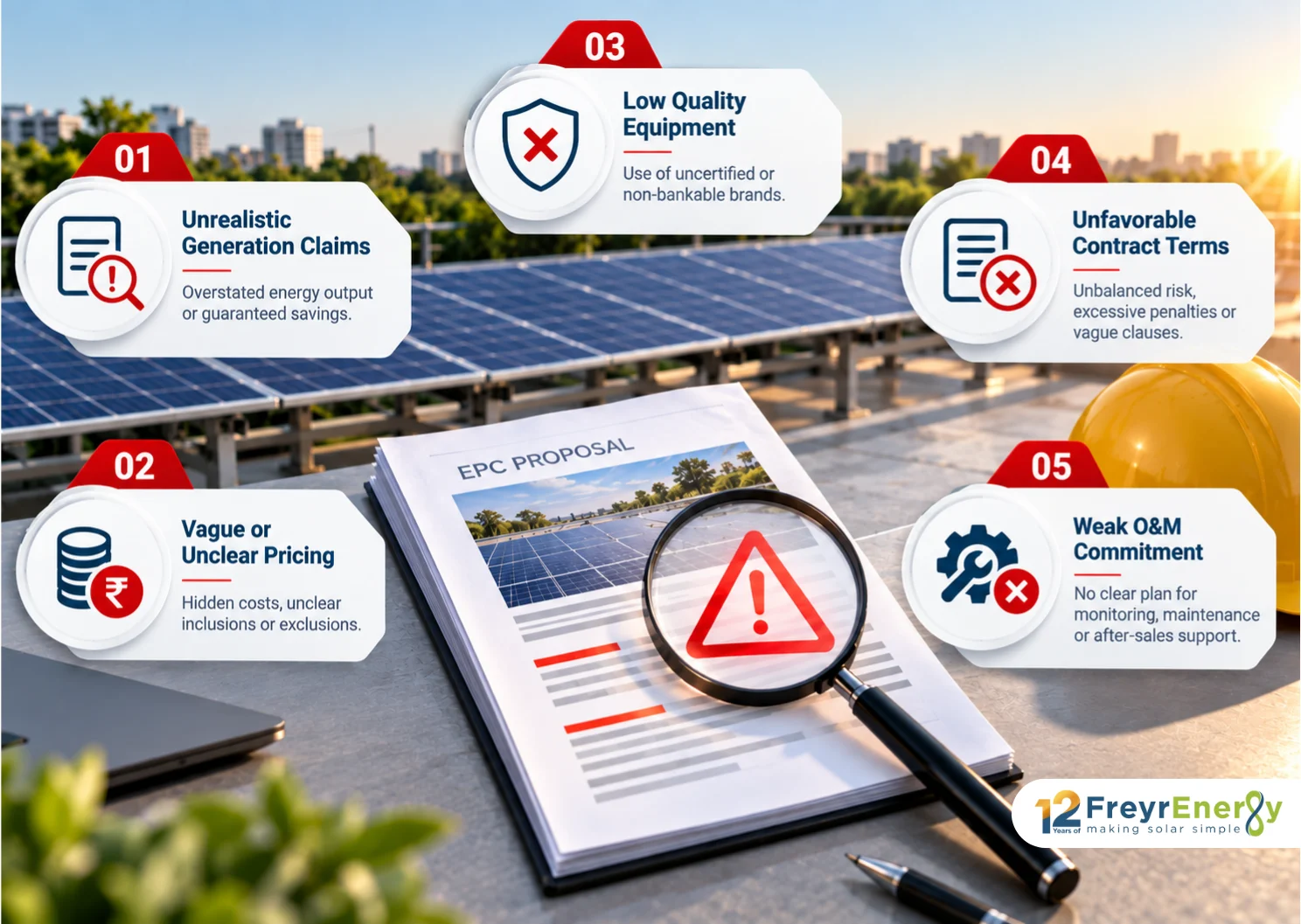
- Guaranteed savings or payback without showing tariff, generation and self-consumption assumptions
- Only a lump-sum price, with no itemised bill of quantities or exclusions
- Unspecified module or inverter model and broad substitution rights
- Generation estimates without weather data, loss table or modelling basis
- No structural review for a rooftop project
- Vague responsibility for DISCOM, metering, permits and shutdowns
- Payment substantially completed before performance testing and handover documents
- “Lifetime monitoring” without service response, data access or platform continuity terms
- No clear workmanship warranty, O&M scope or warranty-claim owner
Why consider Freyr Energy as a solar EPC partner?
Businesses should first define their selection criteria: site-specific design, coordinated execution, transparent monitoring and long-term support. Freyr Energy’s verified public information aligns with those needs for rooftop solar projects: the company has served homes and businesses since 2014, reports more than 21,000 customers and over 150 MW of installations, and provides customised design, installation and monitoring support.
Freyr Energy’s published capabilities include 3D design and shadow analysis, project and payment tracking, solar monitoring through the Freyr Energy Solar App, and post-installation support. About Freyr Energy Final system design, equipment, warranty coverage, service scope, price and timeline remain project-specific and should be confirmed in the signed proposal and contract.
Selected Freyr Energy C&I project examples
| Project | Published scope | Why it is relevant |
| Allu Cinemas, Kokapet | 727 kW commercial rooftop system; Freyr reports that it meets 60% of the site’s energy requirement | Shows application beyond factories, with a large daytime commercial load |
| Sanvira Biosciences, Visakhapatnam | 368 kW rooftop system on an operating industrial site, with monitoring and a reported 16-week design-to-commissioning period | Shows the value of engineering around production operations and transparent performance data |
| Reitz India | 650 kW rooftop system executed in two phases, with remote monitoring and energy-management integration | Shows phased industrial execution and the importance of monitoring after commissioning |
Project details are company-reported and should be read in their full context: Allu Cinemas case study, Sanvira Biosciences case study and Reitz India case study.
Solar EPC services and local execution
Freyr Energy’s approved service information identifies active coverage in Andhra Pradesh, Telangana, Maharashtra, Madhya Pradesh, Uttar Pradesh and Kerala. Project feasibility, service availability and execution capability should be confirmed for the exact pin code and project capacity before commitment. Businesses can also use Freyr Energy’s Solar Experience Centres in selected cities to inspect components and discuss rooftop design and monitoring before making a decision.
Explore commercial solar solutions, Solar Experience Centres or contact Freyr Energy for a project-specific feasibility assessment.
Benefits, limitations and mitigation
| Potential benefit | Practical limitation | How to manage it |
| Lower purchased electricity during solar hours | Savings depend on load coincidence, tariff and export treatment | Model interval consumption and self-consumption before sizing |
| Productive use of roof or land | Shade, structure, access, flooding or competing uses can reduce feasible capacity | Complete structural/site feasibility and preserve access and fire pathways |
| Long-term energy-cost visibility | Generation varies and components degrade or can fail | Use conservative modelling, monitoring, preventive maintenance and clear warranties |
| Support for sustainability goals | Environmental claims require a defined methodology and auditable data | Retain meter data and document calculation boundaries |
| Potential resilience when paired with storage | Grid-tied solar alone usually shuts down during outages for safety | Define critical loads and assess storage/control design separately |
| Single-point EPC accountability | Contract gaps can still split responsibility among vendors | Use a detailed scope, responsibility matrix and acceptance criteria |
Business checklist before requesting an EPC proposal
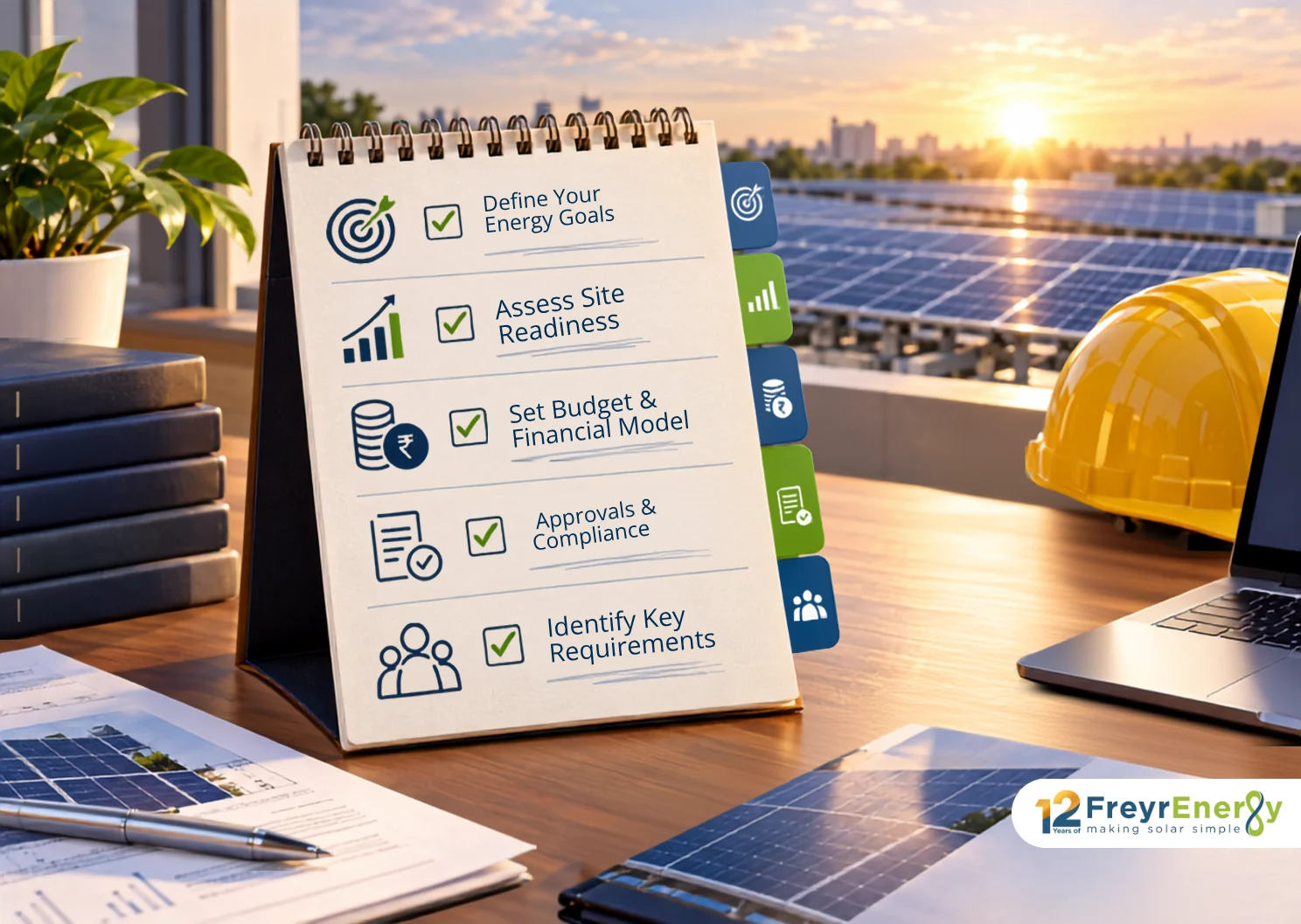
- Last 12 months of electricity bills and available interval load data
- Sanctioned load, contract demand, tariff category and transformer details
- Roof/land drawings, ownership or lease rights and planned site changes
- Operating hours, shutdown constraints and critical loads
- Current and planned equipment that may change consumption
- Preferred ownership model: CAPEX, financed CAPEX or OPEX/PPA
- Internal hurdle rate, payback expectation and sustainability targets
- Named technical, finance, legal, tax, safety and facilities stakeholders
- Requirement for storage, EV charging, open access or future expansion
- A common request-for-proposal format so every EPC bidder answers the same questions
Conclusion
Choosing a solar EPC company in India is ultimately a decision about engineering quality, commercial transparency and long-term accountability. Begin with your load and site, insist on a defensible energy model, freeze equipment and exclusions, clarify approvals and test the project against realistic operating scenarios. Then compare contractors on relevant experience, contract quality, safety, service and lifecycle value—not only the headline price. For businesses considering rooftop solar in Freyr Energy’s active markets, the next practical step is a site-specific feasibility assessment and an itemised proposal that makes assumptions, responsibilities and performance expectations visible before investment approval.