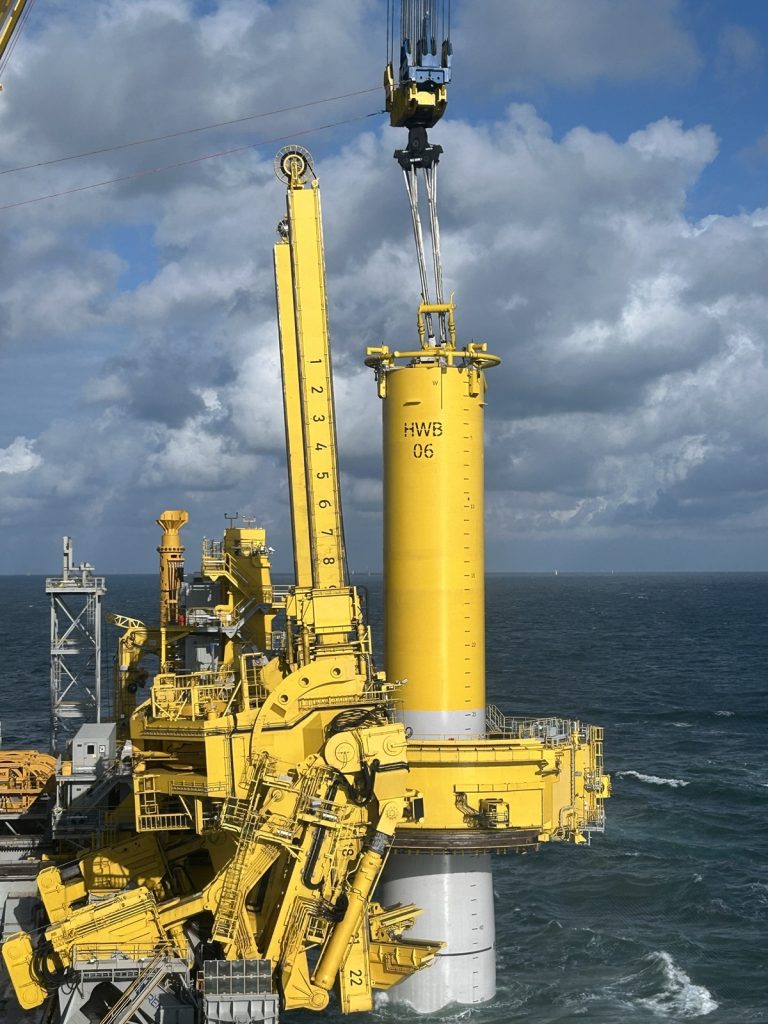
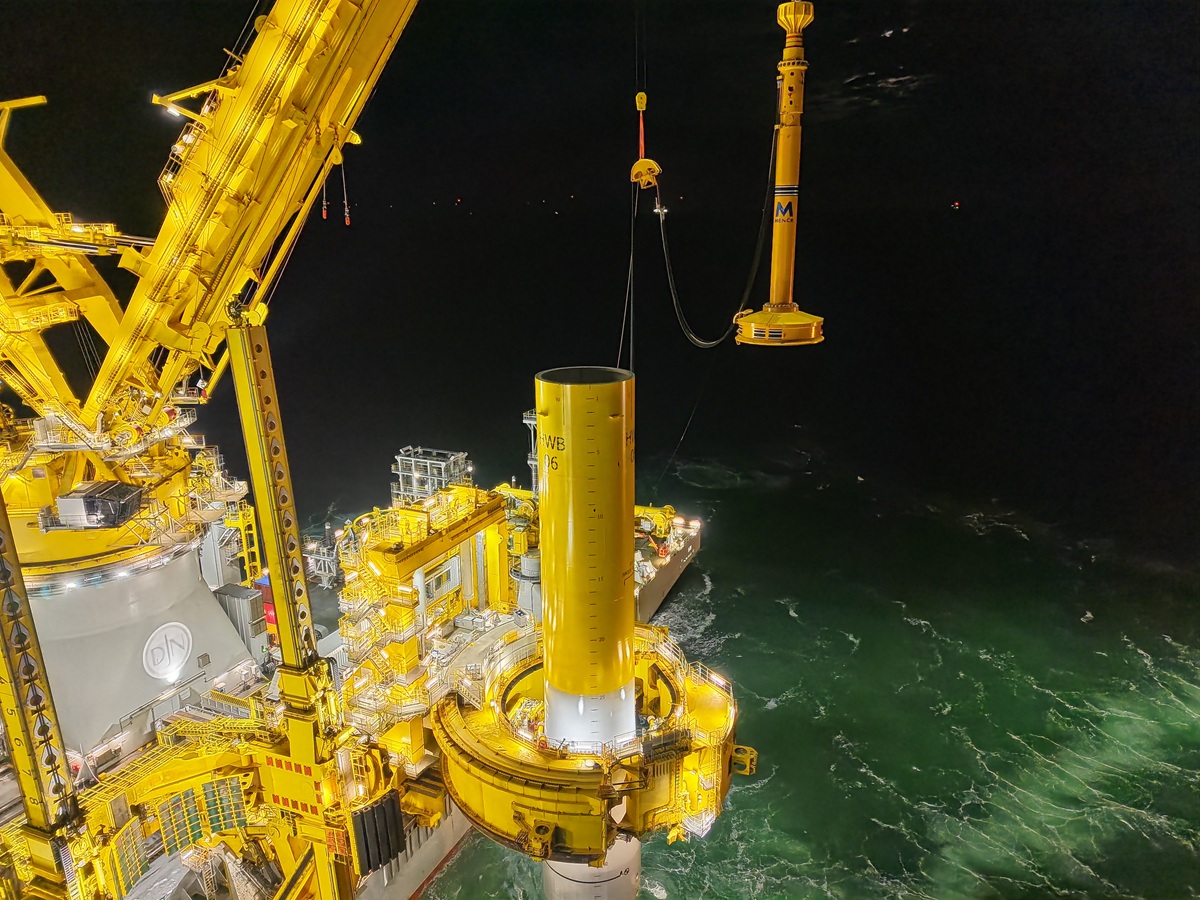
The first monopile has been installed at the 795MW OranjeWind offshore wind farm, located 53 kilometres off the coast of IJmuiden in the Dutch North Sea. The milestone marks the start of offshore construction on the project, which is being developed by RWE and TotalEnergies.
OranjeWind will comprise 53 turbines, with installation of the monopile foundations expected to be completed by early 2027. The turbines are scheduled to be installed during 2027, with the wind farm due to enter full operation in 2028.
OranjeWind monopile installation
The project is using transition-piece-less monopile foundations, allowing the turbines to be bolted directly to the foundation’s top flange. The design reduces the amount of steel required compared with foundations incorporating a separate transition piece.
Secondary steel structures, including the main access platform, internal cassette and boat landings, will be fitted directly to the monopiles during a separate installation campaign.
Each foundation is approximately 90 metres long and 8 metres in diameter. The first monopile was transported from Sif’s terminal at Maasvlakte, near Rotterdam, to the offshore site aboard Jan De Nul’s heavy-lift installation vessel Les Alizés.
The vessel is operating under a long-term charter arrangement between Jan De Nul and RWE. It uses dynamic positioning to position the foundations and is equipped with a 5,000-tonne crane with a maximum lifting height of 160 metres. Once positioned, the monopiles are driven into the seabed using a hydraulic impact hammer.
Les Alizés is classified as an Ultra-Low Emissions Vessel and is fitted with air-emission control systems designed to reduce NOx and fine-particle emissions beyond existing MARPOL requirements.
Noise mitigation during piling
A bubble curtain is being used during foundation installation to reduce underwater noise from piling. Compressed air is pumped through a hose around the piling location, creating a barrier of bubbles that absorbs and reflects sound waves.
Noise levels will be measured outside the bubble curtain to verify that emissions remain within applicable limits.
Inter-array cable installation is planned for the end of 2026. Once completed, the 795MW wind farm is expected to produce enough electricity to supply the equivalent of one million Dutch households each year.
The project will also support TotalEnergies’ plans for green hydrogen production for its refineries in Northern Europe. Source (including image credits): RWE