
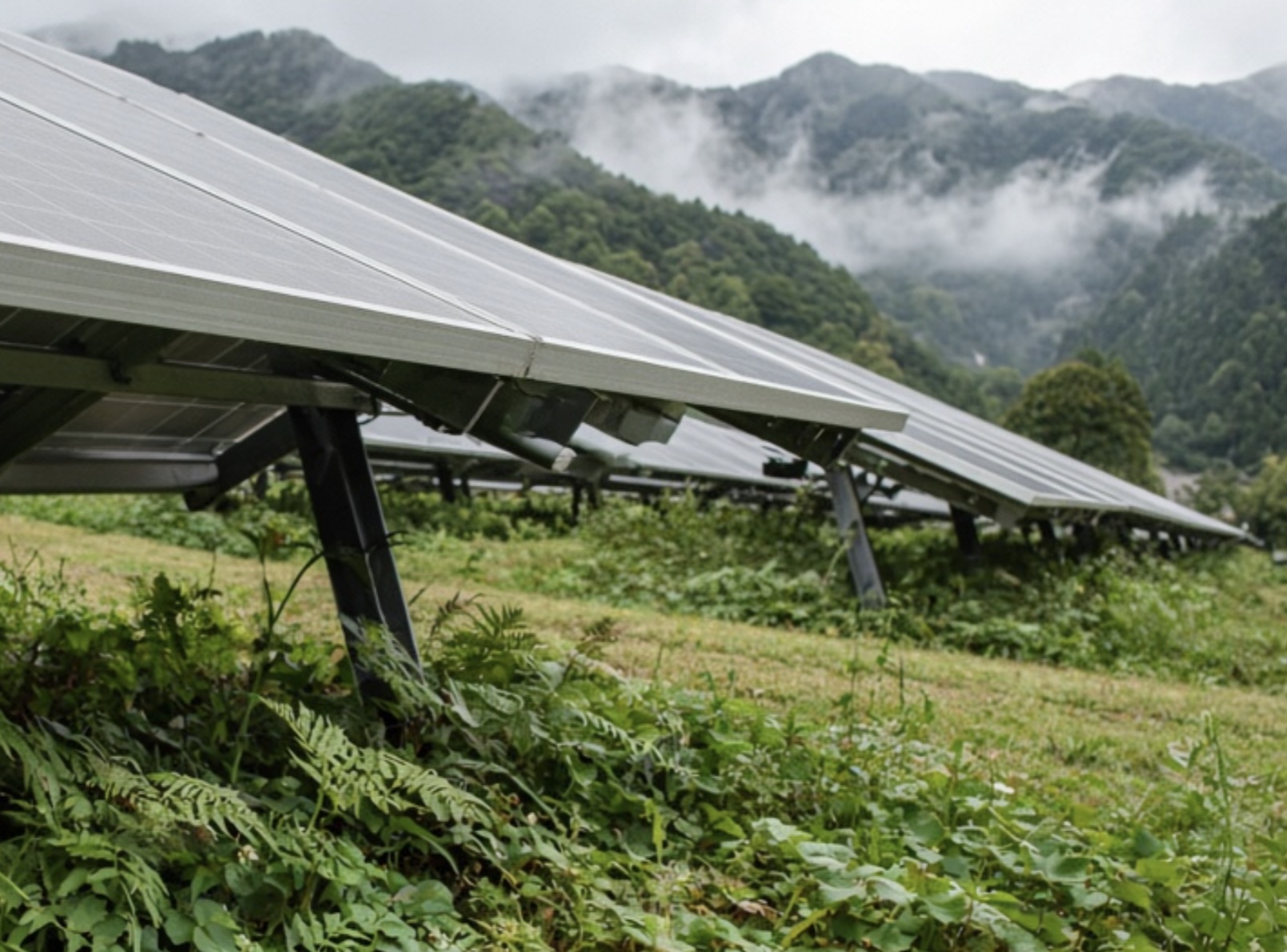
A solar plant built on a former golf course in Japan’s heavily forested Gifu prefecture has developed diverse native vegetation under its panels without seeding or herbicides, according to a new study.
Japanese researchers Miharu Nakatani, Akira Noda and Takeshi Osawa surveyed the 169-hectare, 55 MW plant in the city of Gujo, operated by Pacifico Energy since July 2019. Apart from a commercial seed mix sown on exposed soil before operations began, the site has been managed only by mowing twice a year.
The team recorded 211 plant species from 54 families across 60 sample plots in summer and fall 2024, comparing five settings: under panels near the forest, under panels near open grassland, between panel rows, open grassland, and the surrounding forest edge.
They said that they did not find any significant difference in species richness or diversity between the five settings. However, species makeup did differ.
Vegetation under the panels resembled that of the forest edge, including shade-tolerant ferns, and differed most from the open grassland, where Miscanthus – a tall, fast-growing perennial grass – dominated. Non-native species covered less ground than native species in every setting, particularly under the panels, said the scientists.
Shade and shape
The researchers attribute the result to two key factors. Panel shade filtered out sun-loving grassland species and favored forest plants, and the plant’s intricate layout on steep terrain kept every point within about 200 meters of the forest, allowing seeds to disperse throughout the site. Even under-panel plots farther from the edge, about 85 meters on average, resembled forest-edge vegetation.
The scientists described the approach as “passive ecovoltaics,” in which solar plants become semi-natural habitat through natural succession and minimal maintenance rather than the active seeding used at many European and US sites. Earlier studies, largely in European farmland, have found lower plant diversity under panels.
The new Japanese model depends on a strong seed supply from surrounding land and a site shape that lets seeds reach its center, according to the scientists. They estimate that seed supply would likely be restricted where a facility’s center lies more than 1 km from its edge, and they warned against “greenwashing” where solar replaces grassland that supports rare or sun-loving species.
The study covers one site and one year of surveys and did not measure shade, moisture or soil conditions directly. The researchers are now calling for multi-year studies across several facilities.
Policy fit
The findings come as Japan increasingly tries to steer solar away from land conversion. Small- and medium-sized plants on forest land covered at least 84.7 square km in Japan by January 2020, about 59% of such installations, according to research cited by the scientists. Japan tightened forest development permits for solar in April, and new ground-mounted commercial solar will lose feed-in support from April 2027.
Japan’s energy agency has proposed four categories for continued priority solar support but excluded former golf courses, ski resorts and abandoned farmland, citing the tree felling, topsoil removal and grading such projects can involve. The measures, published on Sept. 30, follow a package of countermeasures on large-scale solar approved in December 2025.
Panel shading is also at the center of Japan’s agrivoltaics rules. The Ministry of Agriculture, Forestry and Fisheries (MAFF) plans to cap shading at 30%, a threshold the Japan Renewable Energy Foundation (JREF) has called unreasonable.
The scientists described their findings in “Passive Ecovoltaics: Solar power plants as semi-natural ecosystems via spontaneous succession in forest landscapes,” which was recently published in the Journal of Environmental Management.