
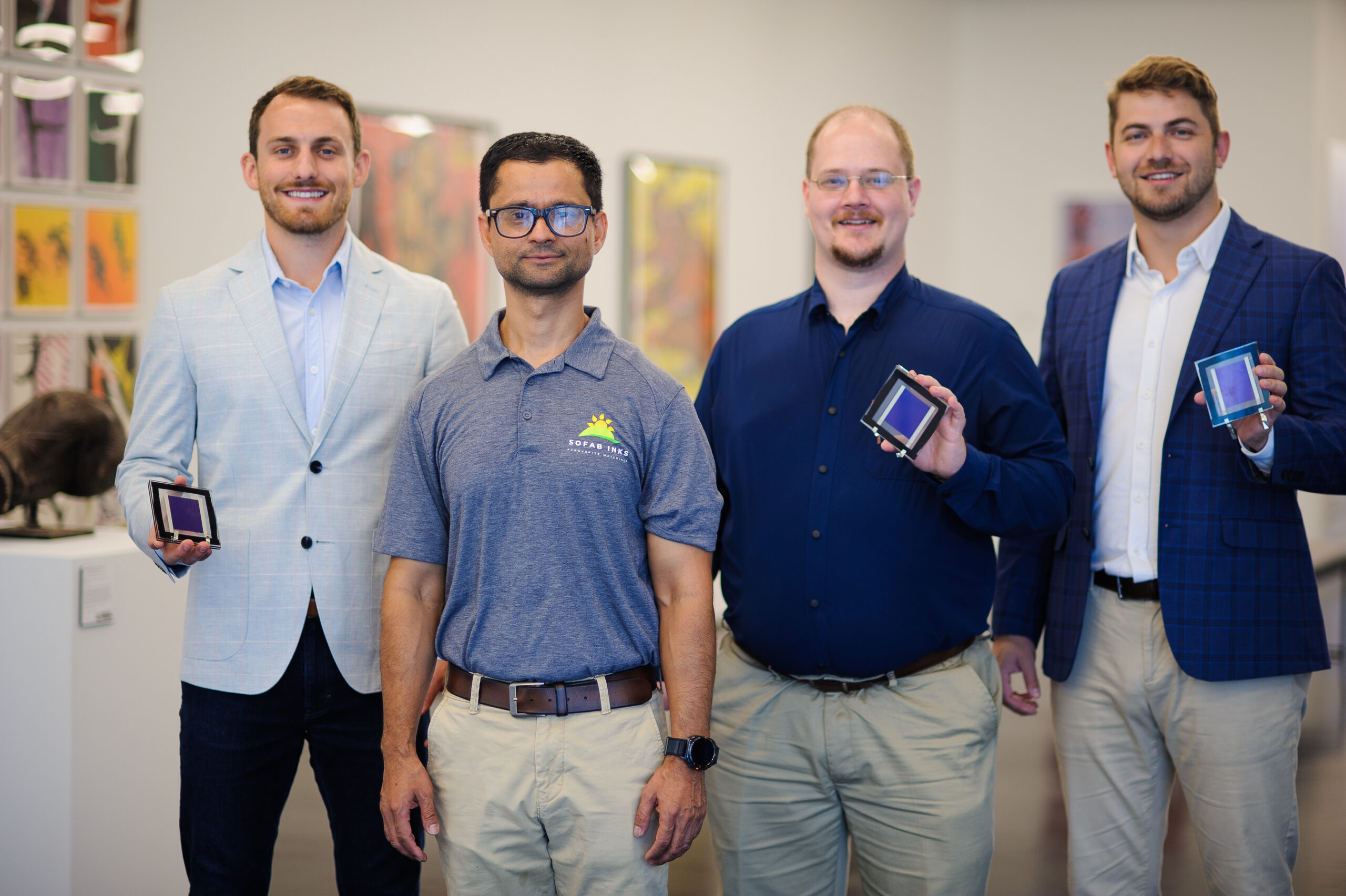
Sofab Inks, a manufacturer of functionalized metal oxide materials based in Louisville, Kentucky, has announced it has raised a $6 million round of seed funding.
The startup said it will use the funding to support the adoption of its Tinfab nanoparticle material, which serves as an electron transport layer (ETL) in advanced perovskite solar cells.
In April, the company announced a breakthrough in perovskite durability, after Halocell modules containing the Tinfab ETL demonstrated approximately 100% normalized efficiency following 1,300 hours under accelerated combined light and damp-heat testing of 1,000 lux illumination, 85% relative humidity and 65 C.
“Tinfab has proven itself at pilot scale and on production equipment,” Blake Martin, co-founder and CEO of Sofab Inks, told pv magazine. “This round is about getting it into customers’ hands: translating that performance to each manufacturer’s site, building out the data package and support that makes integration fast, and scaling our manufacturing so supply is never the bottleneck.”
Martin added that the main benefit of the Tinfab material is increased performance compared to industry-standard C60 ETL.
“A perovskite cell is only as good as its weakest layer, and the industry has been stuck with C60, a fullerene,” he explained. “That’s the layer we replace. Our metal-oxide nanoparticles bond six to ten times more strongly than C60 and hold up at real sizes, running at 22.3% on 30-centimeter single junction modules. This funding moves us into high-velocity production as we triple our engineering team to manage the 1x to 100x scale-up for 1×2 meter commercial specs.”
Indeed, while C60 offers high efficiency and reproducible results in laboratory settings, researchers and manufacturers have identified it as a major limiting factor for commercial scaling. According to 2025 research from the National Renewable Energy Laboratory (NREL) and Arizona State University, published by the American Chemical Society, the interface between the perovskite layer and C60 is a significant source of voltage loss.
Furthermore, C60 is mechanically fragile, and its low fracture energy can lead to delamination, resulting in early failures under field conditions. The researchers in the ACS paper point out that fullerene-related delamination has been observed in cells in the laboratory and in modules in the field.
Sofab Inks says it is “already commercially engaged or in late-stage discussions with approximately 90% of the perovskite industry,” and touts a number of current partners, including Alpha Precision Systems, which builds the slot-die coating and drying systems used to apply perovskite inks at scale; Energy Materials Corporation, which focuses on high-speed, roll-to-roll printing of pure perovskite; and Halocell and SunXT, which are working to bring commercial products containing the Tinfab ETL technology to market.
The funding round was led by Cloudberry Ventures, a venture capital firm launched in 2024 by former Google executive Mahir Sahin.
“Sofab Inks is redefining the ROI of climate investment by making solar panels significantly more efficient than anything available today,” said Sahin in a statement. “Our investment reflects our confidence in Sofab’s trajectory as they solve a critical technical bottleneck and scale production to meet the global demand for innovative materials for next-generation solar.”