
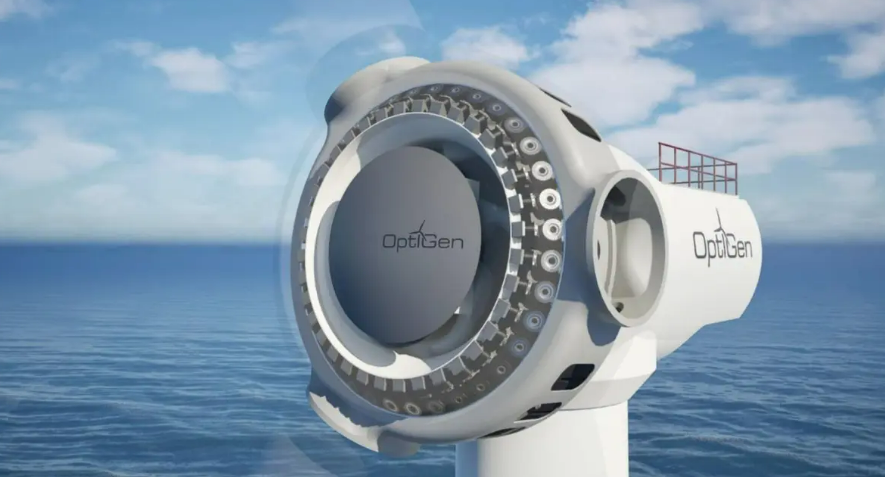
European research project LIGHTWIND, which includes Dutch research organisation TNO among its partners, is moving its OptiGen drivetrain concept into a second testing phase following positive results from its initial trials.
The project is developing a modular drivetrain architecture for offshore wind turbines above 15MW, with the longer-term objective of addressing some of the engineering challenges created by continued turbine upscaling. A key feature of the OptiGen concept is a wheel-and-rail system positioned close to the generator air gap, replacing the large main bearings used in conventional drivetrain arrangements.
LIGHTWIND OptiGen drivetrain targets turbine upscaling
As wind turbines become larger, the generator and supporting components also grow, adding mass to the nacelle. This is an increasing engineering challenge for offshore turbines and could be particularly significant for floating wind, where the weight of the turbine can influence platform requirements, stability and cost.
LIGHTWIND is therefore pursuing two related but distinct objectives. The OptiGen architecture is intended to distribute mechanical loads across smaller support elements rather than relying on a large single bearing and generator assembly. At the same time, its modular configuration is designed around individual units that can be monitored, maintained or replaced separately.
The developers say the latter could reduce the need to remove an entire drivetrain for maintenance and avoid some major offshore lifting operations. Potential knock-on benefits from a lighter drivetrain could include reduced structural requirements elsewhere in the turbine, although the project has not yet established final weight or performance figures.
First tests lead to further development
The initial test programme was based on a preliminary design derived from the IEA Wind 15MW reference turbine. The project team assessed the most critical components, including fatigue behaviour, wheel and rail operating conditions, mechanical loads and suitable materials.
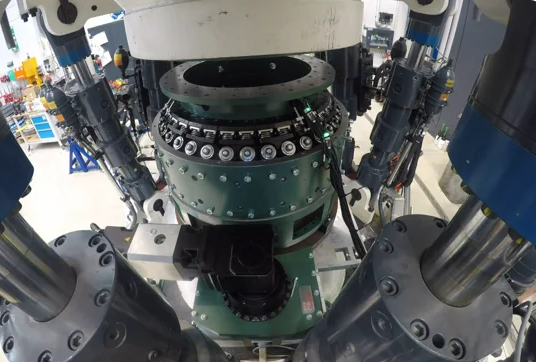
A dedicated test rig was built to reproduce the relevant operating conditions on an accelerated basis. Dynamic behaviour was also investigated using the Beat 1.1 hexapod, developed by IDOM and located at Fraunhofer IWES in Hamburg.
A 1:10-scale OptiGen drivetrain was tested on the Fraunhofer IWES rig. The results have enabled the consortium to proceed to a further testing stage, with modifications and adjustments now being introduced based on the first campaign.
LIGHTWIND is targeting Technology Readiness Level 4 through the ongoing development and validation programme.
From 22MW towards 30MW
The project will also design a 22MW OptiGen drivetrain using IEA Wind Task 55 as a reference and investigate how the architecture could scale towards 30MW.
The work is not limited to a single drivetrain configuration. OptiGen is also examining potential applications of the wheel-and-rail principle in geared drivetrains and in yaw and blade-pitch systems.
The latest project results and plans for the next development phase are due to be presented at WindEnergy Hamburg.
The LIGHTWIND consortium consists of TNO, Fraunhofer IWES, DIS/Creadis, HCMR, MarinRes, Euro-Funding, X1Wind and OptiGen. The project is funded by the European Union. Source (including images): LIGHTWIND