
AI data centers are changing the duty cycle expected of battery energy storage. Alongside conventional requirements for backup capacity and renewable-energy integration, operators must manage rapid load changes associated with high-density computing. A single battery architecture is unlikely to meet every requirement efficiently.
The distinction begins with response time. At the source-grid interface, storage can support renewable integration, demand management, and frequency regulation. Within power-distribution systems, batteries must sustain high output during short interruptions. At server-rack level, even shorter fluctuations require millisecond-scale intervention.
EVE Energy structures its AIDC offering around these three layers. For source-grid applications, its 20-foot, 5 MWh high-power storage system is designed for 1P operation and frequent cycling, with 93.6% system efficiency and an operating range of −40°C to 55°C. Its S5-1P system uses dedicated 315 Ah frequency-regulation cells with 395 Wh/L energy density. EVE reports no lithium plating under specified 1P charge-discharge and 1.22P frequency-regulation tests — demonstrating cell stability under demanding high-rate operation.
For longer-duration applications, the Mr.Giant 3.0 system integrates 6.9 MWh in a standard 20-foot container using 702 Ah cells. Published specifications include a 10,000-cycle system life at 70% state of health and a system temperature difference of no more than 5°C. Actual performance depends on operating conditions.
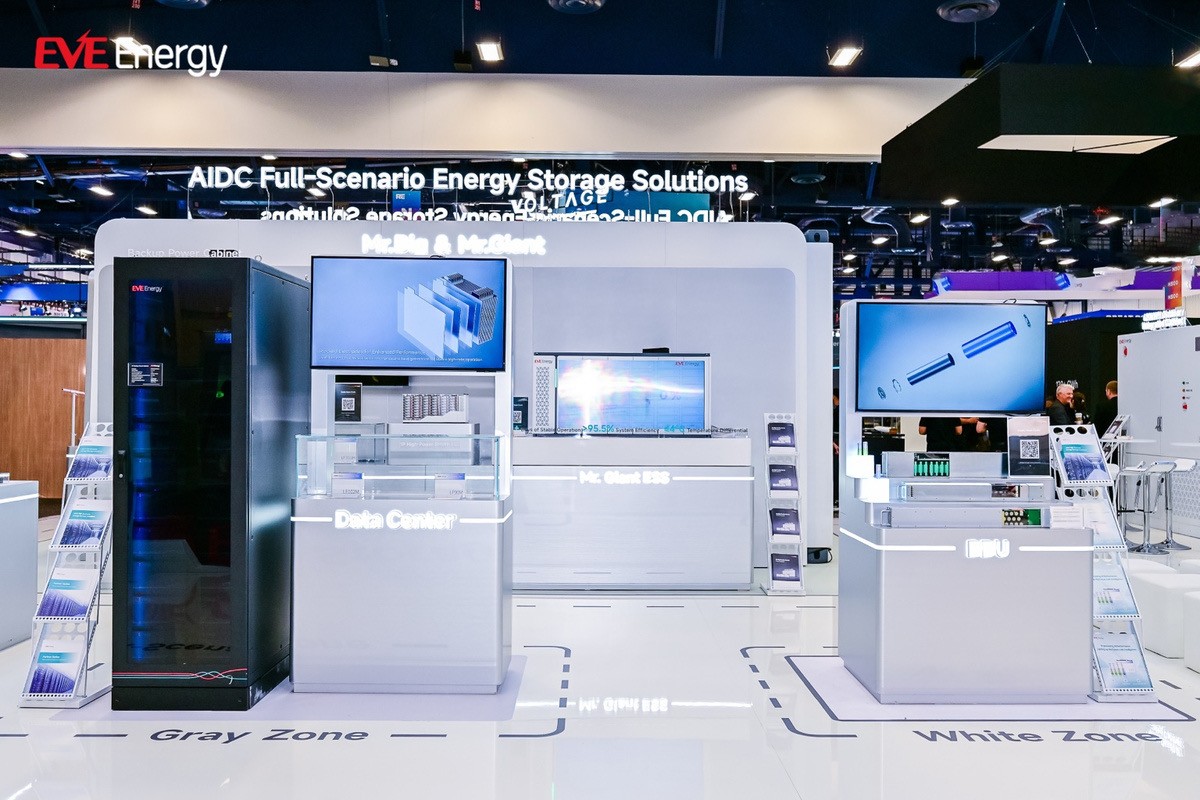
At the distribution layer, EVE’s 6C/10C backup cabinets target high-power, short-duration loads and compatibility with UPS and high-voltage DC architectures. The 10C configuration delivers a specified 660 kW over five minutes. At rack level, its battery backup unit uses 21700 LFP cylindrical cells, supports 15C–30C discharge rates, and specifies switchover within 2 milliseconds.
Coordinating cell behavior, battery management, power conversion, and operating strategies across these layers affects reliability and total cost of ownership. EVE combines cell development with BMS and system integration, offering operators a unified engineering interface.
The portfolio is being presented at the EVE Energy booth (N717 North Hall) at RE+ 2026, in Las Vegas, where the growing overlap between energy storage and digital infrastructure is becoming a practical design consideration for developers and system integrators.