
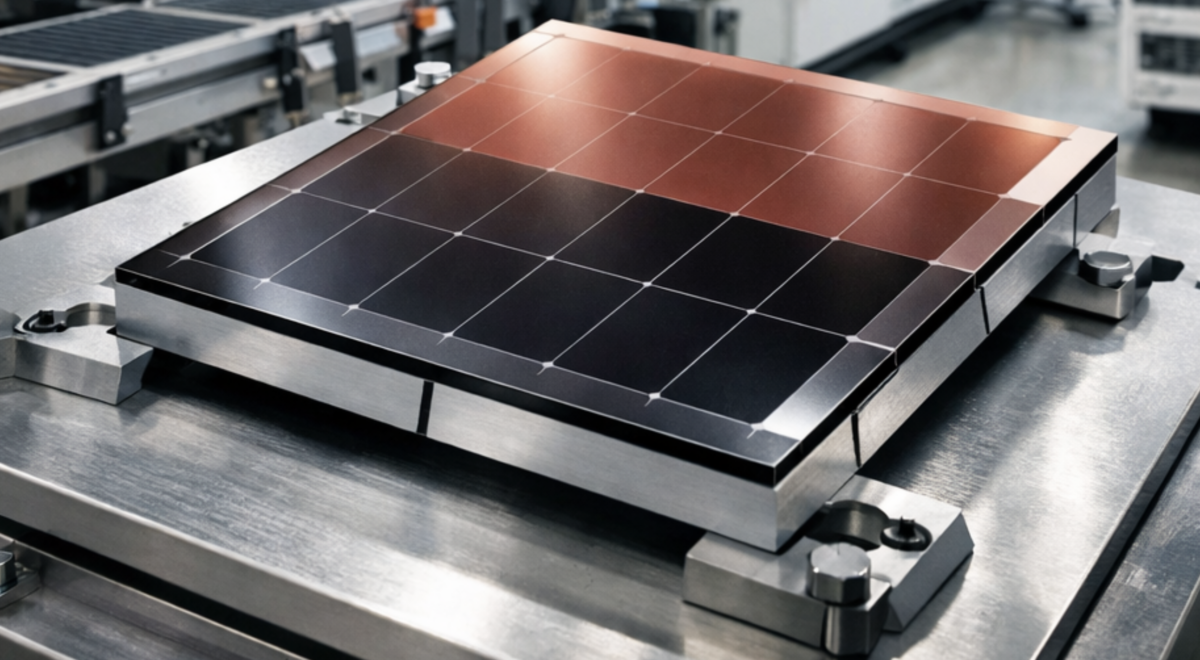
Fraunhofer Institute for Solar Energy Systems ISE has opened a dedicated lab in Freiburg, Germany, to scale perovskite-silicon tandem cell designs to large wafer formats using industry-standard processes.
Fraunhofer ISE has opened a new lab in Freiburg, Germany, to move perovskite‑silicon tandem PV closer to industrial production.
The institute has already exceeded 33% efficiency on a laboratory scale using a hybrid manufacturing route combining vacuum and wet chemical deposition.
Its new Pero-Si-SCALE lab extends that work by scaling the technology to wafer formats of 210 mm x 210 mm using high-throughput, industry-standard processes. It aims to give German and European PV manufacturers access to independent R&D infrastructure for perovskite-silicon tandem cells and modules.
Adding a perovskite layer just 500 nanometers thick to a conventional silicon cell raises the theoretical efficiency limit from 29.4% to 43.3%. Fraunhofer ISE said its hybrid route retains compatibility with standard textured silicon cells already in industrial use, achieving a higher energy yield from finished tandem modules.
Prof. Dr. Stefan Glunz, head of the Photovoltaics Division at Fraunhofer ISE, said tandem solar cells are key to achieving higher efficiency, enabling more solar energy in a smaller area with less material usage. “Photovoltaics is far from being ‘fully researched,’” he said.
The Pero-Si-SCALE builds on Fraunhofer ISE’s Photovoltaic Technology Evaluation Center (PV-TEC), a 20-year-old industry-oriented silicon PV platform. PV-TEC will supply optimized silicon bottom cells to the new lab and maintain continuity with current production processes, said Priv.-Doz. Dr. Ralf Preu, also head of the Photovoltaics Division.
Von Ardenne GmbH, whose vacuum coating systems are installed at the lab, said its equipment is being used in the new facility.
Fraunhofer ISE Director Andreas Bett said funding from the German Federal Ministry for Economic Affairs and Energy (BMWE) has enabled Fraunhofer ISE to maintain an internationally competitive research position that supports local industry partners.
Perovskite-silicon tandem cells have been advancing rapidly on efficiency. Fraunhofer ISE recently recorded 30.6% for a perovskite-silicon tandem built on an industry-standard tunnel oxide passivated contact (TOPCon) bottom cell, while JinkoSolar pushed the benchmark to 34.76% using n-type TOPCon wafers.
The Pero-Si-SCALE opening also connects to broader European manufacturing ambitions – a joint SolarPower Europe and Fraunhofer ISE report found that targeted policy intervention is essential to closing the cost gap with Chinese producers and reaching the European Union’s 30 GW annual manufacturing target by 2030. At the research infrastructure level, the EU-funded Laperitivo project, which includes Fraunhofer ISE among its partners, is separately advancing large-area perovskite module pilot production through February 2028.
This content is protected by copyright and may not be reused. If you want to cooperate with us and would like to reuse some of our content, please contact: editors@pv-magazine.com.