
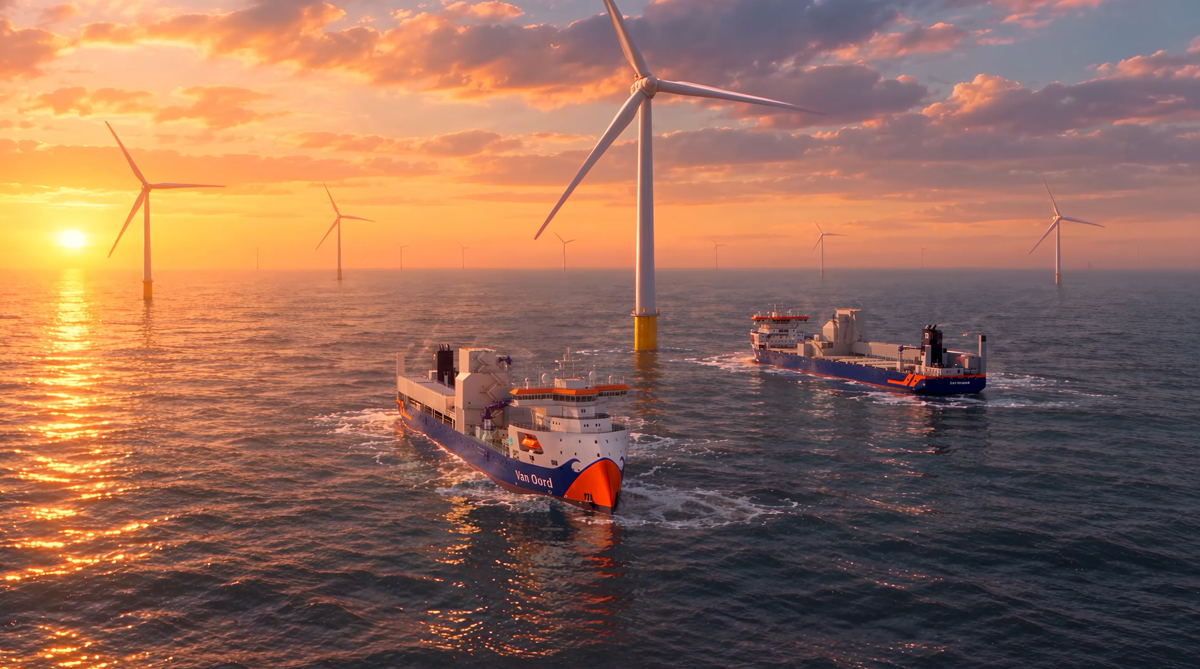
Van Oord Announces Construction of Advanced Flexible Fallpipe Vessels: Vindnes and Vestnes
Van Oord has unveiled its plans for two new purpose-built flexible fallpipe vessels, named Vindnes and Vestnes. These vessels will enhance the company’s capabilities in installing rock for offshore wind energy and other subsea infrastructure projects. Scheduled for delivery in 2028 and 2029, respectively, the vessels are currently being constructed at Yantai CIMC Raffles Offshore in China, as announced at WindEnergy Hamburg.
Purpose-Driven Design for Enhanced Offshore Operations
Each vessel will possess a substantial loading capacity of 35,000 tonnes and is engineered specifically for subsea rock installation. The design aims to accommodate the increasing scale and distance of offshore wind farms from the shore. Subsea rock installation plays a critical role in safeguarding offshore infrastructure, such as foundations and seabed installations, a field in which Van Oord has been prominent since the 1970s with a specialized fleet of flexible fallpipe vessels.
Both vessels will feature advanced automation and smart sensor technology, along with a DP2 (Dynamic Positioning 2) system for accurate rock placement. Their design will incorporate multi-fuel engines and battery storage to enhance fuel efficiency and minimize operational emissions.
Van Oord has emphasized that the design of these vessels strategically balances rock-carrying capacity, installation speed, fuel efficiency, and operational capabilities, ultimately aiming to reduce both installation time and emissions per tonne of rock placed on the seabed.
Uniquely Engineered for Subsea Rock Installation
In contrast to some recent market entrants that have undertaken conversion projects, Vindnes and Vestnes have been purpose-designed from inception for subsea rock installation tasks. This approach allows Van Oord to integrate operational insights gained over more than fifty years in the industry.
Upon completion, these vessels will augment Van Oord’s existing fleet, which includes the Nordnes, Stornes, and Bravenes. Their introduction is anticipated to provide increased capacity to address the demands of large-scale and intricate offshore wind projects.
Maurits den Broeder, Managing Director of Offshore Energy at Van Oord, commented that this investment aligns with the company’s projection of sustained growth in the offshore energy sector and a rising demand for seabed intervention services.
Vindnes is expected to be delivered in 2028, followed by Vestnes in 2029. Source (including image credits): Van Oord