
REVUB model implementation
To model hydropower operation and dispatch under different levels of VRE hybridization, we used the REVUB model. The model software has been used in various studies to analyse hydro–VRE hybridization in a range of contexts, notably for smart renewable energy targets across West Africa7, aligned water–energy planning in Ghana and Burkina Faso49, enabling cross-border energy and water cooperation between Ethiopia, Sudan and Egypt16, foregoing future hydropower plant investment in favour of solar photovoltaics in Guinée47 and displacing thermal power from Suriname’s grid through enabling a climate-resilient hydro–VRE mix10,46,48. The present study represents the REVUB model’s first application to Ecuador and its first application centred around extreme drought conditions.
The equations and modelling principles of REVUB are explained in its user manual75 and summarized briefly here. In essence, the model serves to derive—at hourly resolution across multiannual periods—bespoke hydropower plant-level operation rules adapted to meet appropriate target loads in conjunction with VRE sources while respecting minimum turbine load and minimum environmental flow needs, constrained by technical and hydrological limitations on turbine- and reservoir-level flexibility, as well as by the requirement to keep water levels within operational ranges and the need to coordinate between different reservoirs in a cascade.
To derive these operational rules, REVUB automatically performs a range of plant-level simulations covering an ensemble of target load levels, running through the ensemble from low to high loads. As the model iterates through ever higher target loads, it must hybridize more and more VREs with the hydropower operation to remain able to meet the target load, and keep adapting the hydropower operation accordingly. In each run, the model starts from the same initial reservoir storage state and marches forwards in time, adapting the amount of turbined water to meet that run’s residual target load for each time step after accounting for the VRE contribution and recalculating the reservoir state at each following time step.
For each ensemble member, REVUB verifies ex post to what extent reservoir-level outcomes are aligned with idealized ‘rule curves’ based on a calibration period chosen by the user. These rule curves represent seasonal drawdown/refill curves according to parameterized, logarithmic–exponential release rules for reservoir outflow75 and take the average river discharge across the calibration period as input. (The choice of calibration period is thus important as it determines how optimistic/pessimistic the rule curves are; usually, for realistic simulations, the chosen calibration period should be representative of historical conditions.) The model then selects as the optimal solution the outcome in which those reservoir-level criteria are best respected (that is, where the target load is neither so low that it would underexploit the hydropower flexibility nor so high that it would unduly strain reservoir operation). That optimal solution, which integrates short-term balancing and flexibility needs with long-term operational adequacy, is associated with a certain optimal target load and optimal VRE capacity, which can be considered ‘hybridizable’ with the investigated hydropower plant.
Cascaded hydropower systems are modelled by REVUB in two possible ways, with either the upstream plant or the downstream plant serving as the ‘leading’ unit, which is the main determinant of cascade operation. The leading unit is always simulated first and co-determines the operation of the other ‘lagging’ unit. If the downstream plant is the leading unit (for example, by virtue of having a higher installed capacity and/or more flexibility owing to a higher number of turbines), it is assumed that the operation of the downstream plant will determine the drawdown of both reservoirs. REVUB models the joint operation of two such cascaded reservoirs on the assumption that any change in cumulatively stored volume across the reservoirs is divided over both according to a given share, that is, ‘harmonized’ operation in which reservoirs usually have synchronized refilling and drawdown. Here, we took this share to be equal to each reservoir’s share in maximum total volume. Once the simulation for the leading unit, drawing upon both reservoirs’ storage capacity, is completed, the model simulates the operation of the lagging unit, now constrained by the needs of the leading unit for cascade reservoir drawdown. This is done by replacing the lagging unit’s regular ‘rule curve’ (see above) with the implied refill/drawdown curve necessary for the operation of the leading unit. If, instead, the upstream plant is the leading unit (for example, because the downstream plant has limited to no storage capacity), the REVUB model uses the simulated outflow of the upstream plant to obtain the inflow of the downstream unit. (Details on cascade modelling and its limitations in REVUB are given in Note 7 of the REVUB user manual75.)
The REVUB model takes various technical hydropower plant data as input (such as rated capacity, bathymetry curves, number of turbines, turbine efficiency, design discharge, ramp rate and critical lake levels), as well as time series describing the hydrological conditions, solar and wind power generation curves, and demand variability, plus several operational parameters, such as the minimum stable load of the hydropower plant as determined by its turbine characteristics or the fraction of inflow effectively used for drawdown and refill purposes. The principal data sources are discussed below and we provide a full, tabulated list of input parameters, as well as their values under all scenarios, in the REVUB input files available via Zenodo76. Those input files can also be used to replicate this study’s scenarios.
The REVUB model can run any scenario of the present study at full hourly resolution in a few minutes on a standard laptop computer.
Hydropower data for the Complejo Paute
For the three plants in the Complejo Paute, monthly river flow data for the modelling period 2011–2024 were obtained from the CELEC SUR data portal52 (noting that the Sopladora plant only started operation in 2016). Net evaporation losses from the surfaces of the reservoirs in the Complejo Paute were estimated to be a second-order effect and were not taken into account given that the Mazar and Amaluza dams impound relatively narrow valleys, resulting in very low values of inundated surface area per unit capacity (0.65 ha MW−1 for the Complejo Paute) and correspondingly low water footprints (see ref. 77 for a comparison of this indicator across hydropower plants on multiple continents). Technical hydropower plant data (see ‘REVUB model implementation’ above) were taken from a range of sources for each individual hydropower plant and are documented and listed in the REVUB model input file provided on Zenodo76. In the cascade system (with Paute Molino receiving Mazar outflow plus some lateral inflow into Lake Amaluza52,57 and Sopladora receiving Paute Molino outflow through a discharge tunnel78), Paute Molino was defined as the leading unit in both cases (see ‘REVUB model implementation’ above and also Supplementary Note 2).
The REVUB model was calibrated with observational data by comparing time series data of monthly lake levels (Fig. 3b) and annual electricity generation (Fig. 3c) between model and measurements. The corresponding calibration parameters in REVUB were (1) the regulation fraction freg determining which share of the river discharge is allocated for regulated use (to calibrate lake level fluctuations) and (2) the turbine efficiency parameter η (to calibrate power generation statistics). Further details on these parameters are given in the REVUB user manual75. The calibration of both parameters leads not only to an encouraging match between model and observations for the lake level and power generation time series (Fig. 3b,c) but also for the length of plant shutdowns in the Complejo Paute in 2024 (Fig. 3d). Full details of the calibration are provided in Supplementary Note 2.
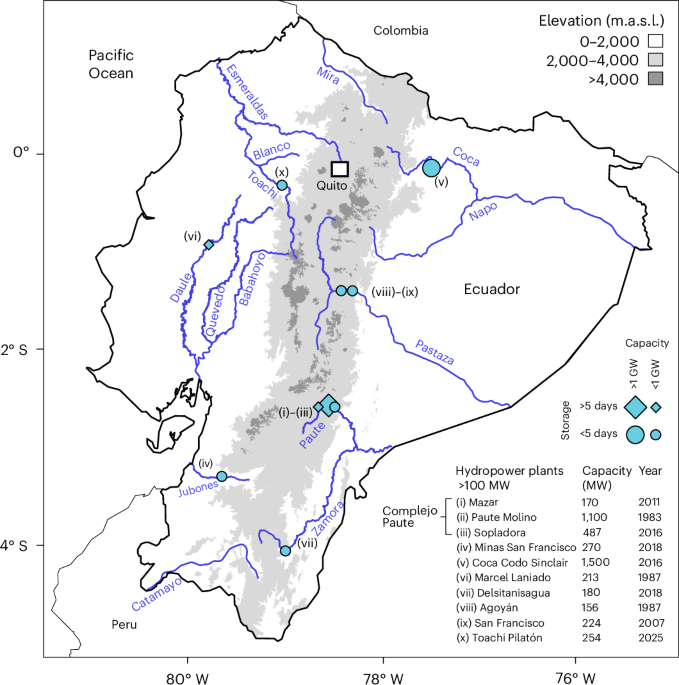
We show in Supplementary Note 11 that the conclusions of this study remain unchanged when running alternative simulations using daily, instead of monthly, averages for Paute River flow, keeping all other things equal. However, daily flow data were available only for the Complejo Paute and the Minas San Francisco plant (plants (i)–(iv) in Fig. 1). For the other hydropower plants (v)–(ix), monthly resolution at most could be obtained and certain years were missing in the time series (see ‘Full power mix simulation’ below). Thus, we believe it is instructive to have a scenario with all input discharge data at monthly resolution so as to make it clear that the analysis also yields useful results at this resolution.
Solar and wind power data
Geospatially resolved solar and wind power generation curves were based on the open-source Model Supply Regions (MSR) methodology developed originally by the International Renewable Energy Agency (IRENA) for Africa79 and later replicated for Central and South America by the authors of this study80. The methodology combines the kilometre-scale spatial resolution of the Global Solar Atlas81 and Global Wind Atlas82 with the hour-scale temporal resolution of the meteorological data available in the ERA5 reanalysis dataset83. MSR datasets include hourly capacity factor curves for the most attractive locations for solar and wind power plant development within each country’s territory, where the recommended criterion for attractiveness is the estimated plant-level levelized cost of electricity (LCOE). In the MSR methodology, the capital expenses of necessary grid expansion, depending on the remoteness of the resource, are included in this LCOE calculation (see also Supplementary Note 12). Areas deemed unsuitable due to adverse terrain, slope, conflicting land use, presence of natural reserves or prohibited locations, high population densities and other factors (described in ref. 79) are excluded. Thus, the dataset gives the individual contiguous areas, ranked by LCOE from low to high, that could house solar or wind power plants at kilometre-scale resolution and with hour-scale generation curves for each.
Here, we started from the dataset in ref. 80, creating a screened selection of attractive areas by taking the best-ranked ones (in LCOE terms) up to a coverage of 5% of Ecuador’s territory and then a subselection of candidates for hybridization with hydropower by taking all areas falling within a 200-km radius of the Complejo Paute (Supplementary Note 3). As the LCOE includes grid expansion costs, this automatically excludes locations with prohibitive transmission build-out requirements. In the case of wind power, the identified locations match closely the sites where Ecuador has already built utility-scale wind farms: the sites of both the 16.5-MW Villonaco project and the 50-MW Minas de Huascachaca project are part of the subselection. (For solar power, such a comparison cannot yet be performed due to the absence of large-scale solar farms in the country, but the clusters match well CELEC’s analysis of solar photovoltaic potential in Ecuador84.)
Given Ecuador’s high average elevation, the probable additional costs in transporting, installing and maintaining wind turbines at high altitudes must be taken into account, as well as potential special turbine design requirements85. While the Villonaco wind farm (which entered into service in 2013) is located at about 2,650 m.a.s.l., the Minas de Huascachaca project (from 2023) lies at the much lower altitude of 1,100 m.a.s.l. We chose here to make a further refined subselection for wind power and focused only on the locations below 2,000 m.a.s.l. as we assumed that, in the case that Ecuador opts for the kind of fast and extensive deployment of VREs suggested here, it may prefer to exploit lower-lying high-potential locations first. However, we ran an additional scenario including all wind locations below 3,000 m.a.s.l. as a sensitivity check (see ‘Scenario design’ below).
The VRE profile envelopes in Fig. 2d represent weighted averages of site-specific capacity factors across the aforementioned subselections for the full period of 2011–2024, with lower and upper bounds given by monthly minima and maxima. To make the solar and wind envelopes easily comparable (as the average capacity factor is ~19% for solar and ~54% for wind), both envelopes were normalized by the respective resource’s average capacity factor across the entire period of 2011–2024.
For the results shown in Figs. 4–6, we used a single year’s meteorological data for VREs throughout the modelling period for demonstration purposes. The reason for this was that the interannual variability and spread in seasonal variability of VREs are vastly inferior to that of river flow, and VRE yield is practically independent of drought occurrence. Thus, for the purposes of investigating hydro–VRE hybridization, the interannual variability of VRE yield plays an insubstantial role compared with that of hydropower (details and visualizations are given in Supplementary Note 11). Here we chose the meteorological year 2018, which appears to have been one of the most ‘average’ years in the investigated period: it was the year in which both Paute River discharge and yield at the Villonaco wind site were closest to their average across the modelling period52,57,86. We show in Supplementary Note 11 that the conclusions of the study remain unchanged when using the full 2011–2024 time period for hourly VRE yield instead of a single weather year.
Demand variability
To represent the hourly-to-seasonal variabilities in electricity demand profiles, we used the Ecuador demand curve from the dataset provided in ref. 87 containing synthetic demand profiles for all countries in the world obtained using a model that decomposes load profiles into a sum of harmonic functions at various timescales (hourly, daily, weekly and seasonal). The model in ref. 87 considers a range of explanatory variables, including peak-to-average demand, temperature regimes, gross domestic product, population size, industrial production and day duration, and was calibrated to the real load profiles of several dozen countries across all continents. The set of calibration countries did not include Ecuador, but neighbouring Colombia was included (as were Mexico, Argentina, Chile and Brazil, the other Latin America countries to be included).
In our REVUB simulations, it was assumed that the target load that the hydro–VRE mix should meet has the same normalized shape as the profile extracted from ref. 87. The target load curve thus equals this normalized hourly profile multiplied by a certain average target load level expressed in megawatts; as explained above, for each scenario, the model cycles through an ensemble of low-to-high target load levels to identify the optimal level that the hydro–VRE configuration of each scenario can meet while respecting all constraints in that scenario. The REVUB results thus show how hydropower would need to be operated such that the hydro–VRE mix performs load-following for a certain fraction of Ecuadorian hourly power demand; the remainder of that power demand was then assumed to be met by thermal power or imports, insofar as capacity is available (see Figs. 5 and 6 and ‘Full power mix simulation’ below).
While there is uncertainty in using a synthetic hourly load shape from the literature, in our view, there was no credible alternative. Even if we had had access to the hourly load profile from 2024 from the grid operator, that load data would already have included the blackouts and load shedding events implemented by the Ecuadorian government (an extreme form of demand response) to cope with the drought and thus would not have been usable for the investigation.
Scenario design
The presented scenarios S1–S4, as well as a further scenario S5, can be summarized as follows:
S1 represents the reference scenario, in which the Complejo Paute is operated flexibly to follow target loads, without considering VRE integration.
In S2, the Complejo Paute operation is hybridized with solar power. The production curve of solar represents the weighted average of production profiles across the identified subselection of solar power sites from the MSR analysis (see ‘Solar and wind power data’ above).
In S3, the Complejo Paute operation is hybridized with a mix of solar and wind power. The capacity mix of solar and wind is fixed at 50% solar and 50% wind, meaning that each megawatt of solar power in the hybridized mix is matched with 1 MW of wind power. (This 50:50 split is intended to demonstrate the different effects of solar and wind integration, not as an ‘ideal’ mix. A cost-optimal ratio of solar and wind power would be determined through long-term cost-optimization tools; see also the Conclusion and discussion.) We used the identified subselection of wind power sites below 2,000 m.a.s.l. (see ‘Solar and wind power data’ above).
S4 is the same as S3, except that the simulation constraint limiting overproduction of the hydro–VRE mix (compared with the target load level) is substantially relaxed (from being allowed 10% of the time to being allowed 35% of the time, inspired by ref. 16). This allows more VREs to be hybridized with hydropower by accepting higher levels of instantaneous VRE overproduction compared with the hydro–VRE target load.
For a sensitivity analysis, one further scenario (S5) is defined, which is discussed in Supplementary Note 13: S5 is the same as S4, except that the wind power site subselection is extended to cover suitable locations with a maximum elevation of 3,000 m.a.s.l.
The precise simulation settings for each scenario can be found in the REVUB model input file available via Zenodo76.
Modelling prudent reservoir operation
Prudent reservoir operation was modelled as follows: after having identified the optimal hydro–VRE hybridization solution for each scenario (see ‘REVUB model implementation’ above), referred to here as regular operation, we re-ran the same scenario for a ‘reverse ensemble’ of target load levels, starting just below the optimal load level identified for regular operation and incrementally reducing it. With a marginally lower load to meet in each reverse ensemble member, the strain on the hydropower plant is eased progressively, raising average lake levels across the modelling period and reducing the probability of plant shutdowns occurring in the crisis period. The ‘prudent scenario’ shown in our analysis corresponds to the first solution in the reverse ensemble in which the total duration of shutdowns of the Paute Molino plant in 2024 reaches zero.
Introducing prudency into the operation tends to have a slight negative effect on hydropower generation in normal years as less water is turbined (the water balance being closed by the reservoir having less buffer capacity in the wet times of the year due to overall higher water levels, thus leading to the release of more water through spillways; Supplementary Note 6). Accordingly, the capacity for supporting VREs tends to be somewhat diminished too. However, there are exceptions: in some cases, the increase in the hydraulic head resulting from the increased average water levels can compensate for this foregone turbined water. In our simulations, this was the case for Mazar, whose generation of hydropower was nearly invariant between regular and prudent operation.
Full power mix simulation
We also ran REVUB simulations of Ecuador’s principal hydropower plants outside the Complejo Paute (those shown in Fig. 1) to perform the analysis presented in Figs. 5 and 6. Those hydropower plants were modelled as run-of-river schemes due to minimal or absent storage, except for the Marcel Laniado plant (vi), whose dam impounds the 6,000 million m3 Daule Peripa reservoir; it was assumed that Marcel Laniado would behave according to S1. The other (run-of-river) plants were modelled assuming that all incoming inflow is immediately turbined, with an upper cap on production set by the design discharge of the turbines75. The Toachi Pilatón plant (x) was not modelled as it only became operational in 2025, after the crisis.
For the Minas San Francisco plant (iv), monthly river discharge data were obtained from the plant operator CELEC52; for all other hydropower plants outside the Complejo Paute, the data were taken from the annual reports of the grid operator CENACE57. In some individual years, for certain hydropower plants, these annual reports only provided the yearly average river discharge for that year instead of the monthly variability, in which case the average monthly variability across all remaining annual reports was bias-corrected to the reported yearly average river discharge for the year with missing monthly data to obtain a proxy time series at monthly resolution for that year. For all hydropower plants, the turbine efficiency parameter η was used to calibrate REVUB outcomes to average power generation statistics from the same CELEC52 and CENACE57 sources (full results of the calibration for all simulated hydropower plants are provided in Supplementary Note 2).
In Fig. 5b,c, ‘hydropower’ represents the sum of the production of the nine hydro plants (i)–(ix) explicitly simulated with REVUB under each scenario, plus a correction term to account for the fact that the power generation of those nine plants, according to the 2024 CENACE annual report, represented slightly above 80% of the production of Ecuador’s full hydropower fleet in that year51 (the remaining 20% coming from 48 further hydropower plants, most of which have installed capacities of ≤20 MW). This correction term corresponds to the summed hydropower time series of plants (i)–(ix) under the ‘S1 regular’ reference scenario multiplied by a correction factor of 20% and subsequently averaged at a monthly timescale. Thus, the assumption is that those remaining 48 hydropower plants (1) have the same aggregated seasonal profile as plants (i)–(ix), (2) behave identically under all scenarios and (3) do not contribute to flexibility provision and VRE hybridization. In the same figure, VREs represent the sum of the VREs hybridized with the Complejo Paute as per the REVUB simulations.
Using the REVUB simulation output, the needs for thermal power and imports in 2024 were then calculated ex post at the hourly level as the difference between the demand curve and the sum of hydro and VRE generation, with the demand curve representing the product of the normalized load profile and the annual average load according to the grid operator51 (see ‘Demand variability’ above). Whenever the sum of hydro and VRE generation exceeded the demand curve, the need for thermal power and imports was defined as zero and the difference was interpreted instead as the potential to export electricity, as indicated in Fig. 5b(i),c(i) (see also Supplementary Note 8). Whenever the needs for thermal power and imports exceeded the capacity that Ecuador had available in 2024, the difference was defined as unmet demand (see ‘Identifying capacity and generation deficits’ below).
Identifying capacity and generation deficits
The unmet demand in Fig. 5b,c and the capacity and generation deficits in Fig. 6 were calculated by comparing the hourly needs for thermal generation and imports (see ‘Full power mix simulation’ above) with the thermal and import capacity that Ecuador had at its disposal in 2024. Here, this was taken to be 1,862 MW of thermal capacity88, 450 MW of interconnection capacity with Colombia89 and 80 MW with Peru90. Whenever the needs exceeded the sum of those capacities in a given hour, that hour was registered in the LOLE count, and the difference between needs and capacities for that hour was registered as a capacity deficit (in megawatts) and as a generation deficit (in megawatt hours). The full hourly time series of this difference is shown in Fig. 6a.
The aggregated capacity deficit at the monthly (annual) scale was calculated as the maximum of the hourly capacity deficit during that month (year), while the aggregated generation deficit at the monthly (annual) scale was calculated as the sum of the hourly generation deficit during that month (year). In reality, the generation deficit would probably have turned out to be larger than in our calculation because thermal plants and import lines are not guaranteed to be available 100% of the time when there is a capacity deficit, nor necessarily at full capacity.
Reporting summary
Further information on research design is available in the Nature Portfolio Reporting Summary linked to this article.