
Chile is among the countries that has undergone an energy transformation over the past several years. Government data shows fossil fuels accounted for more than 60% of power generation in 2013; today, Chilean officials say the South American country generates as much as 70% of its electricity from renewable and low-carbon sources, led by a rapid growth in solar and wind power. Solar and wind account for about 40% of total generation, while hydropower is responsible for just more than 20%.
InvestChile, a government agency that promotes the country worldwide to attract direct foreign investment, said Chile received $38.2 billion in foreign investment for energy projects in the group’s 2025 portfolio. The group, along with the Central Bank of Chile, reported that the top foreign investors ranked by total investment stock in Chile include Canada, with more than $40 billion invested, mostly in mining, energy, and infrastructure. The U.S. is second at just more than $25 billion, mostly for energy and technology. The Netherlands has more than $21 billion in investment stock, with the UK at about $20 billion. Spain rounds out the top five, with about $18.3 billion invested, mostly in energy and infrastructure.
ContourGlobal is among the companies expanding its presence in Chile. The company in August said it has started construction of the Los Maitenes hybrid solar-and-storage project in the O’Higgins region. ContourGlobal’s investment combines 131 MWp of solar photovoltaic (PV) capacity with 90 MW/360 MWh of battery storage. ContourGlobal said it has signed an agreement with CATL, a leading battery technology company, for the supply of 3 GWh of storage systems for the Chilean project along with projects in the UK and Greece. Officials said the CATL technology is a containerized liquid-cooling integrated battery energy storage system (BESS) solution built around CATL’s large-format lithium-iron phosphate (LFP) cells. The bundle covers a total of 526 containers each rated at 5.64 MWh, all configured for four hours of continuous discharge.
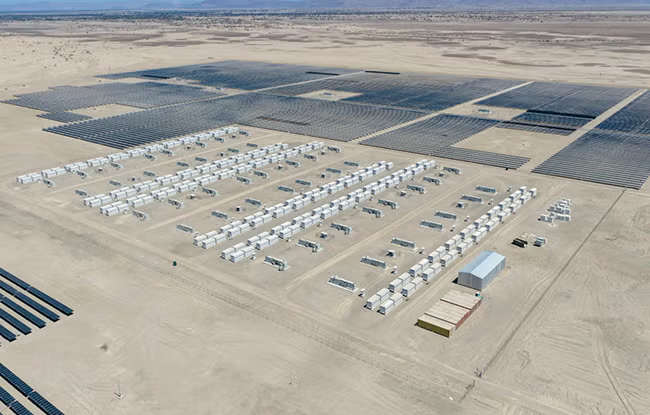
1. The Victor Jara Hybrid Plant in Chile features 231 MWp of solar generation, alongside a 200-MW/1.3-GWh battery energy storage system. Courtesy: ContourGlobal |
The Los Maitenes installation, which is expected to enter commercial operation by year-end 2027, furthers ContourGlobal’s goal of surpassing 1 GW of hybrid power generation capacity in Chile; the facility will increase the company’s Chilean renewables and energy storage portfolio to more than 580 MW of solar power, along with 490 MW/2.9 GWh of battery energy storage. Los Maitenes is located near the heart of Chile’s electricity consumption in the Central Interconnected System. ContourGlobal already operates facilities in the Tarapacá (Víctor Jara) and Antofagasta (Quillagua I and II) regions. The Victor Jara Hybrid Plant (Figure 1) features 231 MWp of solar generation, alongside a 200-MW/1.3-GWh BESS. Quillagua I and II, located in the Atacama Desert, has 221 MWp of solar generation capacity paired with a 1.2-GWh BESS.
“Our growth in Chile goes hand in hand with the transformation of the country’s power system, which is leading the way in combining renewable generation and energy storage to deliver reliable, dispatchable clean energy at scale,” said Antonio Cammisecra, ContourGlobal’s CEO. “Los Maitenes is another milestone in ContourGlobal’s strategy to develop large-scale hybrid renewable platforms, and builds on our pioneering ‘Sun at Night’ business model, which enables solar energy generated during the day to be delivered during non-solar peak demand hours.”
James Lee Stancampiano, general manager for Latin America at ContourGlobal, said, “Los Maitenes marks an important milestone in ContourGlobal’s continued expansion in Chile. This project demonstrates our ability to understand the evolving needs of our customers and the market, and to translate them into world-class, bankable energy solutions. It also reflects our strong local presence and experience in the Chilean energy market.”
AES Andes (formerly AES Gener), a subsidiary of U.S.-based AES Corp., is building two renewable energy projects in Chile with a combined 1.3 GW of capacity, representing an investment of more than $1.1 billion. The Pampas and Cristales projects, located in the northern region of Antofagasta, combine solar power with wind power and energy storage. Pampas has 229 MW of solar PV, 128 MW of wind, and a 171-MW BESS with a five-hour duration, according to AES Andes. The Cristales project includes 288 MW of solar PV along with a 340-MW BESS with a four-hour duration. Both projects are expected to enter commercial operation next year.
AES Andes in October of last year completed Andes Solar Park IV, which features 211 MW of solar PV generation capacity along with 130-MW BESS with a five-hour duration. It also is located in Antofagasta, a region considered to have some of the highest irradiation levels in the world. Andes Solar III began operating earlier this year; it has 171 MW of solar PV, along with a 171-MW BESS with a three-hour duration. The projects are part of the Andes Solar Hub, which is considered the largest installation of its kind in Latin America. The hub to date represents an investment of more than $1.3 billion.
Javier Dib, CEO of AES Andes, said, “The start of commercial operations at Andes Solar III is a source of great pride and a key milestone in our journey, strengthening our Andes Solar Hub as the largest in Latin America and marking the completion of a strategic cycle in our transformation.”
Dib added, “We continue advancing with the construction of more than 2,000 MW scheduled to begin commercial operation between 2026 and 2027. This reflects AES’ strong confidence in Chile as a solid and competitive platform for continued investment in renewable energy. We will keep contributing efficiently and responsibly to the national grid, reaffirming our long‑term commitment to Chile’s sustainable energy development.”
Consorcio Austral, a Chilean developer, in July applied to Chile’s Environmental Impact Assessment System for approval of its $4.7-billion Acuario green ammonia project. The facility is sited in Bahía Gregorio in the Magallanes region. Officials said the project would produce about 4,100 tons of green ammonia per day for export over a 46-year operating life. Hydrogen would be generated through water electrolysis powered by renewable electricity, and combined with nitrogen using the Haber-Bosch process. The Acuario facility would be supported by a massive 1.73-GW wind farm. It would include underground transmission lines, and a BESS. Startup is still years away, with construction expected to begin in the third quarter of 2029 and finish by the second quarter of 2033.
Acuario is the largest non-mining project submitted for environmental review in Chile this year; officials said it signals continued interest in large-scale green hydrogen projects despite weakening global demand. Analysts said the challenges for the hydrogen sector are highlighted by the cancellation of AES Andes’ $10 billion INNA green hydrogen and ammonia project in January of this year. AES Andes officials in announcing the cancellation of the INNA project said the company wanted “to focus its efforts on the development and construction of its renewable energy and energy storage portfolio, in line with the guidelines of its parent company in the United States.”
Colbun S.A., another Chilean developer, earlier this year said it continues work on the 228-MW Diego de Almagro Sur energy storage project (BESS DAS), under construction in the Atacama region. The company said the installation is the first energy storage initiative in the world authorized to sell carbon credits under Article 6.2 of the Paris Agreement for use in Nationally Determined Contributions (NDCs). The NDCs are climate commitments that countries define and report in order to reduce their greenhouse gas emissions and advance climate change mitigation. Joachim Sell, carbon procurement director of the KliK Foundation (a Switzerland-based climate group collaborating with Colbun), said, “I am convinced that projects like BESS DAS will help address challenges in the Chilean power system, such as reducing the curtailment of renewable energy and displacing power generation from fossil fuels.”
Colbun CEO José Ignacio Escobar said, “We have had to demonstrate that our project meets demanding global standards, competing with initiatives from all over the world. Being part of this process together with KliK, which has the mandate from the Swiss government to fulfill its emission reduction commitments, is a very significant opportunity.” Escobar continued, “This type of long-term contract makes it possible to strengthen the development of initiatives that still face regulatory and technological uncertainties. It is a concrete signal that the energy transition requires international collaboration and innovative solutions.”
ENGIE Energia Chile, meanwhile, is closing its last four coal-fired power plants in Chile, and expanding its BESS projects. The 116-MW/660-MWh Tocopilla BESS, at the site of a former coal plant, is online, as is the 14-MW/150-MWh BESS Arica in the Arica y Parinacota region. The 140-MW/802-MWh Lile BESS is expected to come online by year-end. The company recently said it had brought seven generation and BESS projects, with combined capacity of about 1.1 GW, online during a three-month period ending in May of this year.
On the transmission and distribution side, Spain-headquartered ACCIONA Energía has completed the design, implementation, and commissioning of an artificial intelligence–based grid digitalization project in Chile. The company said the work will increase transmission capacity by 60% in the southern section of the country’s National Electric System, known as SEN. The Transfer Control Automation System enables integration of an additional 239 GWh of wind power generation into the Chilean grid. The company said the project “incorporates digital and communications technologies that optimize the Mulchén-Santa Clara 2×220 kV and Santa Clara-Charrúa 2×220 kV transmission lines, located in the Araucanía and Biobío regions and operated by Transelec, Ferrovial, SAESA, CELEO, and Transmisora Sur Andes.” The company added that “system development and implementation has also involved the participation of power generation companies Enel Green Power and WPD and has been validated through advanced simulations conducted by the University of Santiago, Chile, and the National Electric Coordinator.”
—Darrell Proctor is a senior editor for POWER.