
Technical Article
The market for commercial and industrial (C&I) solar energy systems has grown in recent years due to a number of factors: rising energy costs, widespread adoption of energy storage increasing the value of on-site generation, and the increasing availability of capital for energy development. Strong federal tax credits have supported the financial viability of these systems just as they have for residential and larger-scale solar projects.
Recent changes to the 48E Investment Tax Credit (ITC) have affected the ways by which commercial solar projects pencil out. In this new post-ITC era for clean energy development, we expect market dynamics to shift, bringing new challenges as well as opportunities. In a recent Ask Mayfield Anything webinar, I joined Ryan Mayfield and Adam Miller, Chief Revenue Officer at Solarity, to discuss the new market landscape.
We all agreed that we are seeing a shift from the uniform federal ITC to more local state, city, and utility-specific incentives designed to fill the ITC gap and meet local capacity demands and clean energy targets. This creates many opportunities for nimble local project developers, but it is challenging for regional and national stakeholders to navigate disparate markets and make the business case for each unique project. This shift also makes it more necessary than ever for property owners and developers to understand alternative capital structures and the criteria for debt underwriting.
In this article, I will share a few strategies from our independent perspective to navigate C&I project development in this new post-ITC environment.
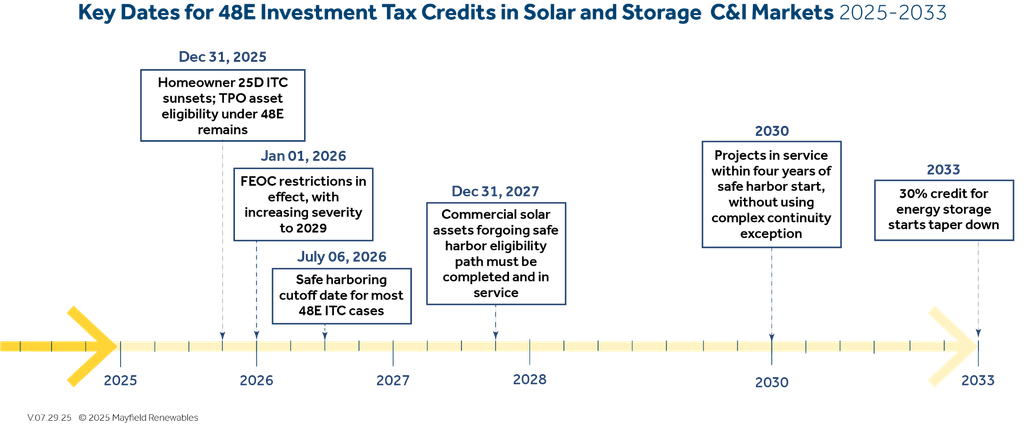
Timeline of key recent and future deadlines for commercial solar and storage ITC.
Assess Financing Options such as Commercial Property Assessed Clean Energy (C-PACE)
One option to consider for your project’s financing, raised in the webinar, is C-PACE, a nationwide financing framework offered through various private capital providers and regional administrators. C-PACE financing enables property owners to finance the full cost of the solar project through long-term, fixed-rate loans. The loan payments are added directly to the property tax bill and spread over a 20- to 30-year period. This arrangement keeps the site owner’s credit lines free because the liability is linked to the property’s assessment rather than to the business’s balance sheet. At the same time, property owners are able to keep the federal tax deductions and depreciation benefits they are entitled to while enjoying a zero-down, large initial capital outlay.
Since C-PACE assessments are tied to the property, any future buyers will have to assume the assessment payments. This long-term alignment means that C-PACE is a good option for property managers seeking to finance rooftop or canopy solar systems, but it may not be right for every site host or owner.
There is also a growing number of investors and private lenders interested in commercial energy projects. We have seen some energy equipment manufacturers and distributors offering capital solutions, as well as traditional banks and lenders. Identify your capital provider partners early and work closely to align on a project’s financial viability.
Revenue Stacking with Battery Energy Storage
Battery attachment rates for solar projects are going up, and for good reason. Battery energy storage systems (BESS) can enable “value stacking,” combining various revenue-generating or cost-saving streams to improve project economics. By including energy storage, commercial systems can earn revenues in addition to those from basic solar net metering. And while the solar PV ITC has sunsetted, there remains a 30% tax credit for commercial energy storage. Solar generation peaks midday and can be stored by the BESS. Businesses can then use the stored energy to avoid utility peak demand charges, which can have a drastic impact on overall economics. This reduction in demand charges, along with the storage ITC, improves the cash flow viability of behind-the-meter clean energy assets.
By combining solar and BESS, system owners may also gain access to newer demand response and grid services programs rolling out in some key markets. In these programs, battery systems can take part in virtual power plant (VPP) schemes and capacity auctions. We expect this trend to expand to more utilities as well as some private hyperscalers with a bring-your-own-capacity model, as the VPP concept is tested and proven. This mutual benefit of improving grid-level stability and capacity while also providing day-to-day site host benefits is a huge opportunity, but a challenging one to navigate with many stakeholders and complex value streams to explain to your financier.
Technical Due Diligence and Equipment Compliance
Without the 30% solar PV ITC, the need for sharpening the pencil on the project economics and technical plan in the early stages could not be more important. Rigorous technical and economic feasibility studies should be conducted to ensure that the planned size of any energy assets (PV, BESS, generator, etc.) matches the site’s specific load profile and intended use case(s). Feasibility should also ensure that technical hurdles are identified and incorporated into the overall budget as early as possible.
Carrying out early site due diligence helps to avoid costly, unexpected changes to the project plan during later stages of development, and ensures your financing partner is secure. By identifying the site’s technical challenges, such as interconnection constraints, as early as possible, developers can prevent cost overruns and preserve project margins. When experienced engineering partners match the electrical design specifications to the utility’s interconnection requirements, AHJ’s permitting requirements, and the system owner’s use cases, a project’s technoeconomic performance can be modeled with higher confidence, which helps increase the financial underwriters’ confidence.
Equipment compliance when participating in multiple value streams, incentives, and economic programs may vary. Developers will need to navigate equipment selection and controls implications when stacking varied program participation.
Moving Commercial Energy Projects Forward
The solar industry has navigated many shifting market dynamics over the last twenty years. What is fundamentally different today in the commercial and industrial market is the overall market need, whether for resilience or to mitigate rising electricity rates. The AMA panel agreed that the financial viability of C&I solar projects is expected to be strong in specific regions.
Key takeaways and recommendations for the near-term path in a post-ITC world included:
- Stay on top of market intelligence as key markets fill the solar ITC gap.
- Identify flexible financing partners early, and develop the relationship to ensure alignment on project plans.
- Couple PV systems with energy storage revenue streams and the battery ITC to improve bankability.
- Sharpen the pencil during a rigorous due diligence and feasibility phase, working with qualified independent engineers on technical due diligence early.
For your next commercial energy project, consider Mayfield Renewables’ engineering services to feasibility studies, system design, and technical due diligence.