
Rondo Energy
Rondo Energy has developed a modular heat battery, called the Rondo Heat Battery (RHB), as a large-scale thermal energy storage system for use across many industries. It’s primarily designed for use in industrial sites as a replacement for fossil-fuel boilers. The RHB has been designed to charge off cheap, renewable energy during the day (6-8 hours charging time), and the energy is converted to heat inside the RHB for use on site. There are two configurations that the RHBs can adopt depending on the intended application: producing heat and steam or producing heat and power.
The main building block of the RHB is a refractory brick that is stacked inside the battery and is heated up using joule heaters (that are powered by renewable energy). The joule heaters convert electricity into thermal radiation during charging, which heats up the thousands of bricks inside a RHB to 1500°C. These bricks can store this heat for days with less than 1% loss per day.
When the heat is needed, it can be discharged by flowing air through the brick stack. The air becomes superheated to over 1000°C and the delivery rate of the heated air is modified by changing the air flow and is delivered at specific temperatures using a control system. The air is eventually recirculated back through the system to minimise heat loss and maximise efficiency.
On the application side, the heat is delivered as superheated air or as superheated steam. Steam can be delivered as dispatchable steam that matches the existing infrastructure, to heat up thermal oils, or directly as heated air. On the combined heat and power side, the steam generated can be used to turn non-condensing steam turbines (with a 95% efficiency) to deliver on-site power as well as heat. While the ratio of heat to electricity varies based on individual needs, the average ratio is 4:1.
The RHB can continuously distribute superheated air―as process heat, steam, or electric power―for over 24 hours with a round-trip efficiency (RTE) of 97-98%. The RHBs are available in different sizes, with rated thermal outputs 2 MW to over 100 MW with unlimited cycles and 40+ year usable life.
Rondo Energy has stated that its heat battery can be used in a wide range of industries, and across many applications within those industries. While the use of thermal energy storage in some industries might be more prolific than others, the following table shows where Rondo Energy has stated that their heat batteries can be used:
| Industry | Use Cases/Applications |
| Aluminium refining | Low to high-pressure steam for digesters, Preheating rotary kilns, Hot gas (1500°C) for alumina calcination, Baseload power generation for smelters and electrolysis |
| Cement production | Kiln preheating, Biomass fuel drying, Raw materials processing, Clay calcination, Clinker calcination |
| Chemical manufacturing | Distillation. Drying & evaporation, Heating, cooling, and reheating solvents and solutions (including polymerisation and crystallisation) |
| Consumer goods manufacturing | Constant steam for sterilisation, drying and product heating, Cleaning |
| Direct Air Capture (DAC) | Steam for sorbent regeneration, Heat and power for DAC processing |
| District Energy Systems | Centralised heating and cooling, Repowering steam turbine cycles. Absorption chillers for cooling and power |
| Renewable fuels production | Methanol synthesis reactor preheating. Distillation and purification of ethanol, Process heating |
| Food and beverage processing | Cooking (smoking, blanching etc) and baking, Sterilisation and Pasteurisation, Drying and evaporation, Fermentation |
| Speciality manufacturing | Sterilisation and cleaning, Precision heating and annealing, Steam in coating and surface treatment, Process heating and space heating. Drying |
| Mining | Ore extraction and processing, Heat and power for smelting, Chamber dryer integration |
| Paper and pulp production | Drying. Evaporation Steam production |
| Petrochemical processing | Superheated steam for steam cracking and distillation, Reforming and hydrotreating |
| Pharmaceutical production | Sterilisation, Drying, Process heating |
| Steel production | Hot air for blast furnaces, treatment furnaces, and pelletising plants Annealing and tempering |
| Textile manufacturing | Dyeing and finishing, Drying and steaming, Pre-treatment and washing |
There are many cases of the RHB in action with partnership installations with Calgren Renewable Fuels, Siam Cement Group and Holmes Western already up and running, and installation still in development/under construction with Heineken and Covestro. The Holmes Western installation is a 100MWh installation that is currently the world’s largest industrial heat battery and is powered entirely by off-grid solar with 24-hour steam output.
Antora Energy
Antora Energy has developed a thermal battery that stores heat in solid blocks of carbon. Antora Energy has stated that carbon was chosen at the heat storage medium because it is one of the most common materials on Earth and is therefore cheap and available, can store a lot of energy, and it has a very high thermal conductivity and heat capacity.
The thermal batteries are charged by resistively heating the carbon blocks, and the energy is stored in the carbon blocks at temperatures up to 2400°C and can be discharged continuously over multiple days to industrial sites. At these temperatures, the bricks are glowing hot and emit light. To stop the energy from the light emissions being lost, Antora has also developed thermophotovoltaic (TPV) heat-to-power technology that converts this light into electricity.
The stored energy in the thermal batteries is either used directly as heat for industrial processes, or the light emissions are converted back into electricity for use elsewhere. The combined heat and power TPV technology is currently in development.
Antora Energy’s Heatcore product is currently available and provides up to 375°C heat, but the in-development Heatmax will enable up to 1500°C heat output. The current commercially available Heatcore product has a 20+ year lifespan with unlimited cycles. It also has a thermal output of 300kW, and a maximum charging rate of up to 900kW (electric).
Antora Energy has stated that its thermal batteries are suitable for a range of industries, including:
- Pulp and paper
- Refining
- Steel and iron
- Renewable fuels
- Food and beverage
- Data centres
- Chemicals
- Mining and mineral
- Concrete and lime
Antora Energy is also commissioning a 50MW/5GWh multi-day thermal energy storage system at POET’s bioprocessing facility in South Dakota. The installation will deploy over 200 of Antora’s thermal batteries to meet this capacity, and it is expected that the installation will go into full operation later this year.
Malta Inc.
Malta Inc. has developed a steam-based ultra-high temperature heat pump for process heat applications as well as long-duration energy storage (LDES). The system is powered by renewable energy and delivers 24/7 300–550°C process heat, with the ability to recover waste industrial heat (roughly 120°C) and upgrade it to process heat. The systems developed by Malta Inc can distribute both heat and electricity from 8 to 200 hours (8 days), a heat output with 180 bar steam (up to 550°C), and 55-60% synchronous electricity generation. For just the advanced heat pump (AHP) itself, it can have multiple input streams with an output process heat flow of at least 1MW that can be used on one or more process streams, including process streams with different temperatures.
It is the Malta Steam Energy Management and Storage (SEMS) that provides steam as a working process fluid and the ability to provide electricity output. Thermal energy is stored in a molten salt and reconverted back into power and heat on demand. The combined heat and power system has a RTE of 85-95% and can be installed in a wide range of configurations from 50-500MW+/0.4-12GWh+.
In terms of the working of the SEMS, renewable energy charges the system, and the inputs of the system are combined with other systems that produce excess heat and steam (this is the recycling and upgrading of waste heat noted above). A heat pump with multiple compression stages and intercooling produces superheated steam that heats molten salt to 565°C. There is also a water reservoir that is used to produce steam when the salt transfers its stored heat to the water. This superheated steam is then either directly extracted for industrial heat/steam applications or is flowed through a steam turbine to produce electricity.
There are three main application markets that Malta Inc have identified for their SEMS combined heat and power systems. These are combined cycle and steam turbine services, process heat for industrial decarbonisation, and LDES. The specific target applications set out by Malta inc in each of these overarching areas is set out in the table below
| Steam turbine services | Process heat | LDES |
| Primary Frequency Control – Frequency containment reserve (FCR) | Iron and steel | Combined Cycle Gas Turbine (CCGT) Transitions |
| Secondary Reserve – Automatic frequency restoration reserve (aFRR) | Refining | Utility-scale combined heat and power (CHP) |
| Tertiary Reserve -manual frequency restoration reserve (mFRR) | Chemicals | Geothermal |
| Voltage Control and Reactive Power support | Pulp and paper | Next Generation Data Centres |
| Black Start support | Food and Beverage | District Heating/Cooling |
| Short circuit support | Aluminium | Desalination |
Brenmiller Energy
Brenmiller Energy’s thermal storage technology, bGen, is a heat battery that uses crushed rocks to store heat that is generated by either renewable energy or off-peak cheap electricity. Brenmiller currently has 103MWh of cumulative projects installed with a 4GWh manufacturing capacity.
To charge the heat battery, electricity is converted into heat using embedded electric heaters stored within an insulated steel vessel. The heat is discharged as high temperature steam, hot air, or thermal oil depending on the application.
The heat batteries dispatch heat at 100–500°C with a 97% RTE. The storage capacity of the thermal energy storage system ranges from 10MWh–500MWh, with a charging load of 2MW–100MW and a heat output of 1MW–80MW. The thermal energy storage system has a lifetime of at least 30 years.
The process heat output varies from application to application. For steam-based outputs, the heat battery dispatches heat up to 500°C, 100 bar pressure, and steam flows up to 100 ton/hr. Hot air outputs and thermal oil applications, on the other hand, are dispatched up to 400°C.
Brenmiller has a few different commercial projects in place. The power-to-heat project with Tempo in Netanya, Israel, has a 32MWh thermal energy storage system with 5.6MW electrical charging from PV and grid, and a 14 ton/hr steam output at 7 bar. The other power-to-heat project in Israel, at Wolfson Hospital in Holon, has a 2MWh thermal energy storage system, 2MW electrical charging at off-peak hours, and 5 ton/hr steam output at 7 bar. The other power-to-heat project that Brenmiller is involved in is the PPF project in Dombovar, Hungary. This project has 30MWh thermal energy storage capacity.
There are also a couple of heat-to-heat projects too. One with Enel in Santa Barbara, Italy, has a 24MWh thermal energy storage capacity that charges with high pressure steam and discharger mid-pressure steam. Another is with Fortlev in Anapolis, Brazil, with a 4MWh thermal energy storage capacity that dispatches at 400°C for plastic processing. There is also a hybrid charging project with SUNY Purchase college in New York that recovers heat from a gas turbine and provides 500kW heat output for campus heating.
MGA Thermal
MGA Thermal has developed a thermal energy storage system using modular thermal energy storage blocks that are stackable and scalable to any size. The systems can be used to supply process heat, steam for electricity generation, or cogeneration of heat and power.
Like many of the other technologies, the thermal energy storage blocks charge when the electricity price is low and/or when there is a lot of renewable energy generation. The technology centres around their Miscibility Gap Alloy (MGA), which is used to manufacture the MGA modular energy storage blocks.
The MGA blocks contain small metal alloy particles dispersed in a matrix. When the blocks are heated from the electrical input, these alloy particles melt and absorb energy in the process. The matrix material itself remains solid and keeps the molten particles held within the block, and in turn keep the stored heat in the block. Heat is released through the cooling of the blocks using a closed nitrogen loop, and the liquid metal alloy turns back into solid particle form. The released heat is either released as process heat or is used to turn a turbine and produce electricity.
The MGA thermal energy storage system has a range of sizes, ranging from 5MWh to 6GWh. The systems have up to 48 hours of storage with an RTE of 93%. For the steam delivery, the steam can be delivered between 150°C–550°C, for both process heat and co-generation installations.
MGA Thermal has stated that their thermal storage systems are suitable for the following industrial and energy applications:
- Alumina
- Building materials
- Petroleum refining
- Pulp & paper
- Oil & gas extraction
- Chemical processing
- Food & beverage
- Wood & wood products
- Textiles & clothing
- Power station retrofit
- Wind energy storage
- Solar power storage
- Greenfield & grid energy storage
- Co-generation
MGA Thermal has successfully launched a 5MWh demonstration plant with a 500kW nameplate thermal power, a steam discharge temperature of 200°C and pressure of 7 bar. The demonstration plant contains around 3700 MGA Blocks, while a 195MWh electro-thermal energy storage project is planned at Tronox’s Kwinana facility in Western Australia with an anticipated operation start date of 2028.
EnergyNest
EnergyNest has developed a thermal battery with electric heaters and control systems that charge the battery―converting electricity to heat―when the energy is cheap. The thermal battery is the core component of all EnergyNest’s power-to-heat systems and are based on a modular solid-state design made from a trademarked material called HEATCRETE and steel. HEATCRETE is a specialist high-performance thermal concrete material that has a much higher heat storage capacity and conductivity compared to conventional concrete.
The thermal battery charges using either electricity from the grid or on-site renewables, and the electricity is converted into heat using an electric heater. The thermal battery contains integrated heat exchanger pipes filled with a thermal oil/heat transfer fluid that is customised to each site based on their needs. The electricity to heat conversion process heats the thermal oil as it flows through steel tubes in the HEATCRETE and transfers energy to the solid-state storage. The maximum charging temperature of the thermal battery is 390°C, with typical charging temperature of 250–390°C.
When the heat is needed, it can be discharged as thermal oil, steam, or hot air. The heat output ranges from 120–300°C, and the typical system size ranges from 5MWh to 1000MWh (a typical 20ft container can store around 2MWh) with a service life of at least 25 years.
EnergyNest has state that the main applications for their thermal battery are:
- Cement & Bricks
- Pulp & Paper
- Glass & Ceramics
- Food & Beverages
- Chemicals
- Steel & Non-Iron Metals
- Engineering, Procurement & Construction (EPC)
- Energy as a Service
- Utilities
In terms of their current projects, EnergyNest has installed a 10MW power-to-heat system with a 40MWh thermal energy storage unit at Tesa in Hamburg. The thermal energy storage system contains 24 modules and delivers a 52% electrification of heat and a 2700-ton CO₂ reduction per year. At Leonhard Kurz in Germany, 3MW electrical heater and a 12MWh thermal battery will deliver over 3GWh of clean heat annually. This will cover more than 70% of the heat demand for one of the site’s production lines. At Avery Dennison in Belgium, a 2.7GWh solar field has been coupled to 6 thermal storage modules totalling 5MWh thermal power. The system will provide all the factories heat demand in the summer and reduce annual greenhouse gas emissions by 9%.
1414 Degrees
1414 Degrees has developed silicon-based thermal energy storage systems that are charged on renewable energy and can produce hot air outputs up to 900°C. Silicon is used in their trademarked SiBrick materials as a phase change material, that becomes molten when heated up, storing the heat inside the brick.
Silicon has a very high melting point (1414°C) and a high energy density, so it can hold a lot more energy in a smaller footprint than other phase change materials that store heat in their molten form. The SiBrick is the cornerstone and fundamental building block of all of 1414 Degrees’ thermal energy storage products.
The SiBrick is currently used in the SiBox product, that has a thermal efficiency of over 90%. The SiBox has been designed to be retrofitted to existing industry processes to provide 24/7 heat. It charges up with renewable energy when the prices are low and is used in combined heat and power systems. While the current heat output is 900°C, 1414 Degrees has stated that they will eventually be able to provide up to 1414°C heat output.
1414 Degrees has stated that their SiBrick/SiBox technology is useful for the following applications:
- Industries that rely on high-temperature process heat above 800°C
- LDES for stabilising the grid
- Cement production
- Alumina processing
- Steelmaking
- Hydrogen production
While the SiBox is the current product, 1414 Degrees also plans to soon launch the SiPHyR, which combines the SiBrick technology with fluid reactor technology. This technology will turn methane into hydrogen and solid carbon through methane pyrolysis. The utilisation of the SiBrick will help to provide a continuous production of hydrogen. The SiPHyR is currently at a technology readiness level (TRL) 2, and 1414 Degrees plans to take the TRL to level 5 in three years, and to TRL 7 (a full-scale prototype in commercial conditions) a couple of years after TRL 5 has been reached.
Polar Night Energy
Polar Night Energy has developed a thermal battery that uses sand (as well as sand-like materials and industrial by-products) as the heat storage medium. The sand battery is available in two main configurations: 2MW and 10MW.
The 2MW system has been designed for small-to-mid-sized industrial facilities, district heating networks, and space heating. It has a 2MW heating power, a capacity up to 200MWh, and an RTE of 85%. The 10MW sand battery has been designed for larger industrial processes, energy companies and district heating networks. This system has a 10MW heating power, capacity of up to 1000MWh, and an RTE of 90%. The system is not sensitive to the type of sand, or its grain size, so cheap sand materials can be used, and local materials are often used.
The sand battery charges, like most thermal storage systems, when the cost is low using renewable sources. The electrical energy is transferred to the sand battery using a closed-loop air-pipe system. This system heats the air using electrical resistors and the heated air is circulated through heat transfer pipes and the heat is transferred to the heat storing sand materials. In their current design, the sand battery stores heat up to 600°C, but the temperature is not limited by the sand (but instead the heat resistance of the construction materials) and higher temperatures are possible if the application demands it.
The heat is removed from the storage system by blowing cool air through the pipes. This air absorbs heat as it passes through storage system due to the difference in the thermal gradient. This heats up the air and the air is then used to convert water into steam (up to 400°C) or heat water for district heating. The system can retain heat for months at a time and is charged/discharged between 20–200 times per year, has a 30+ year service life, and an uptime of more than 8000 hours per year.
Polar Night Energy has stated that their sand battery systems serve a wide range of industries, including:
- Energy utilities
- Residential and commercial building operators
- Food & beverage
- Textiles
- Chemistry and pharmaceuticals
- Metal production
- Pulp & paper
Polar Night Energy already has the world’s first commercial sand battery installed and more are in the pipeline. The Kankaanpää project in Finland was the world’s first commercial sand battery used in a district heating network in conjunction with the energy utility company, Vatajankoski. The installed sand battery has a heating power of 200kW and a capacity of 8MWh and has been in operation since 2022, with an overall efficiency of 60–75%.
Polar Night Energy also has other major projects planned/currently being tested over the coming years. Polar Night Energy is working with Valkeakosk Energia to demonstrate their system’s capabilities to convert the heat back into electricity. This project started in 2025 and will run until 2027. It’s expected that after the project has concluded that the electrical efficiency will be 30–35%, and while low, is in line with combustion power plants. If the sand batteries are used in CHP, then the overall efficiency could be as high as 90%.
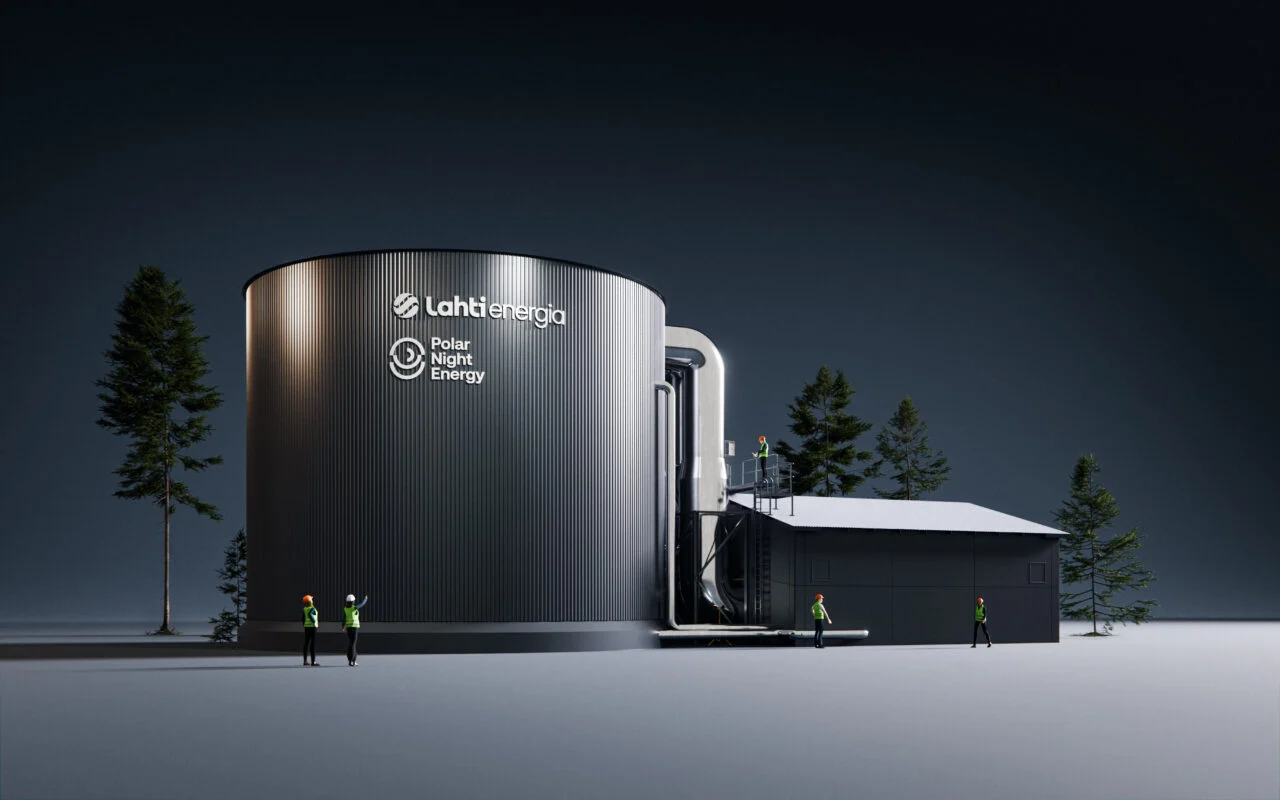
Polar Night Energy and Lahti Energia are also in the process of constructing industrial-scale thermal sand batteries for Lahti Energia’s district heating network in Vääksy, Finland. The installed sand battery will have a 2MW heating power, 250MWh storage capacity, and a storage temperature of 500°C. It will be the largest sand battery once installed, surpassing their own record installation.
Polar Night Energy already delivered a sand battery to Loviisan Lämpö for district heating in the Pornainen municipality of Finland. This battery has a 1 MW heating power and a 100MWh storage capacity. The actual storage medium in this system is 2000 tons of crushed soapstone.
Honourable mentions of companies with thermal energy storage technologies that did not make into this roundup: